
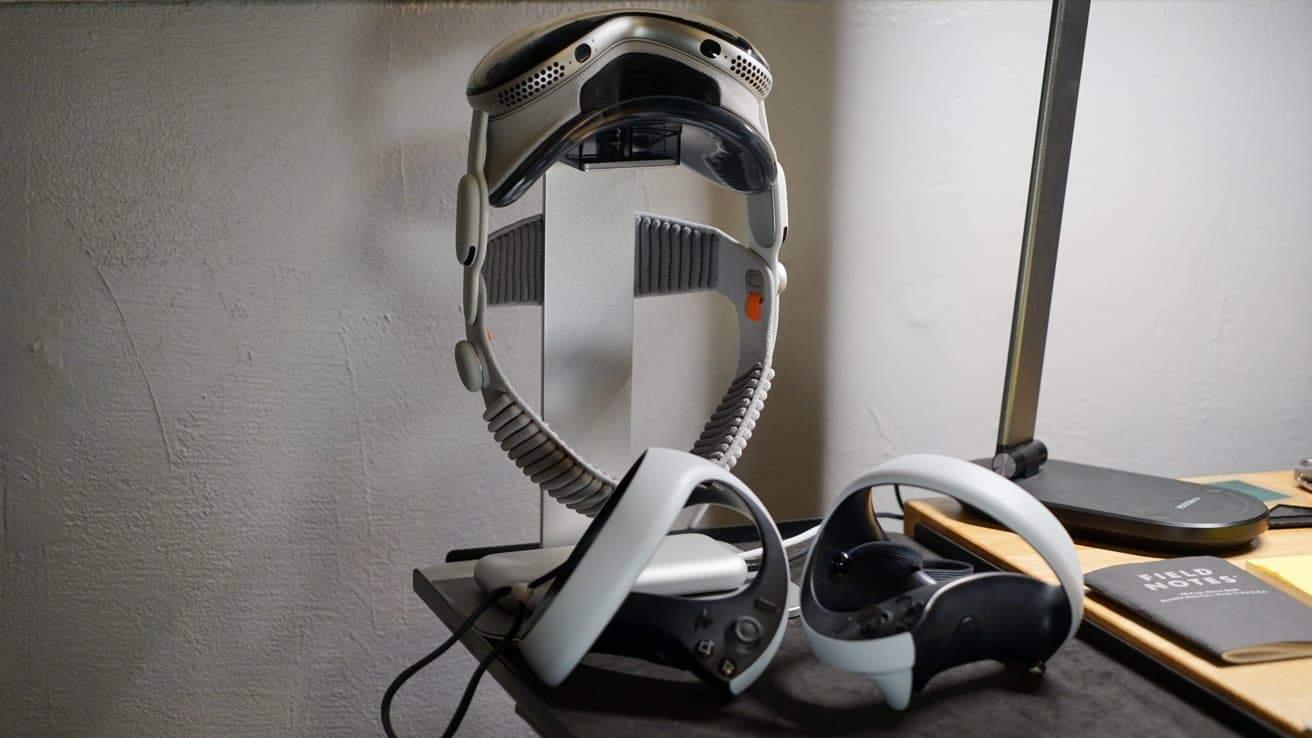
Apple Vision Pro Is About to Get a Lot More Physical with visionOS 27
When Apple unveiled the Apple Vision Pro in 2023, the company made it crystal clear that it had no interest in controllers. Hand tracking and eye tracking were the stars of the show — elegant, hardware-free, and deeply integrated into the visionOS experience. For Apple, putting a controller in someone's hand felt like a step backward. But the market, developers, and users have gradually pushed back on that vision, and Apple has been listening. With visionOS 27, the company is taking its most significant step yet toward embracing physical interaction, bringing expanded spatial accessory support and physical object tracking to its flagship spatial computing headset.
A Brief History: From No Controllers to Spatial Accessories
At launch, Apple Vision Pro relied entirely on hand gestures and eye movements to navigate visionOS. The approach was undeniably impressive from a technological standpoint, but it came with a serious trade-off: the absence of haptic feedback and physical tactile response. For productivity tasks and casual browsing, this worked reasonably well. But for gaming, creative tools, and immersive experiences that demand physical precision, the limitations became apparent quickly.
The only nod to physical controllers at launch was a compatibility layer allowing users to pair a PlayStation DualSense controller for playing 2D iPad games in the headset's virtual environment. It was functional, but it was hardly a ringing endorsement of physical input.
That began to change with visionOS 26, which introduced the concept of spatial accessories — a framework that allowed developers to begin building and integrating hardware companions for Apple Vision Pro. Among the most notable early implementations was support for PSVR2 Sense controllers, which brought hand-tracked physical inputs into the visionOS ecosystem. The groundwork had been laid. Now, visionOS 27 is about to build on it in a major way.
What visionOS 27 Brings to the Table
Expanded Spatial Accessory Support
With visionOS 27, Apple is significantly widening the aperture of what can be built and supported as a spatial accessory. Developers now have more robust APIs and frameworks at their disposal, enabling the creation of controllers and physical objects that integrate deeply with visionOS applications. This isn't just about plugging in a gamepad — it's about enabling a new category of purpose-built spatial hardware that can communicate with the headset in meaningful, real-time ways.
This expanded support means that third-party hardware manufacturers have a much clearer and more capable pathway to build accessories for Apple Vision Pro. Whether that means specialized controllers for creative tools, haptic gloves for immersive gaming, or industry-specific physical input devices for enterprise applications, the possibilities are opening up in ways that simply weren't available before.
Physical Object Tracking
Perhaps one of the most exciting additions in visionOS 27 is physical object tracking. This feature allows Apple Vision Pro to recognize and track real-world physical objects, integrating their position and movement into the virtual environment displayed in the headset. In practical terms, this could mean that a physical prop — a toy sword, a stylus, a training device — can be tracked in real time and represented accurately in a spatial computing experience.
Physical object tracking bridges the gap between the purely virtual and the tangibly real. It is a capability that many competing mixed-reality platforms have explored, and it opens enormous creative and commercial potential for developers building on visionOS. Imagine a medical training application where a physical scalpel model is tracked as the user practices a procedure, or a children's educational app where a physical toy becomes an interactive character in a mixed-reality story.
Why This Matters for Users
For everyday Apple Vision Pro users, the changes coming in visionOS 27 translate to a richer, more immersive, and more interactive experience. The lack of haptic feedback has been one of the most frequently cited criticisms of Vision Pro gaming and interactive media. When you tap your fingers together in mid-air to select an object, you feel nothing — and that absence of sensation can break immersion and limit what game designers can achieve.
With proper controller support and physical object tracking, developers can now design experiences that take full advantage of tactile feedback, precise physical input, and real-world object integration. This is a major unlock for the gaming segment in particular, where the gap between Apple Vision Pro and more controller-centric competitors like Meta Quest has been particularly visible.
Beyond gaming, enterprise and professional users stand to benefit enormously. Physical object tracking has direct applications in fields like surgery simulation, architectural visualization, and industrial training, where the ability to interact with a physical stand-in for a real-world object inside a spatial computing environment could have genuine practical value.
The Bigger Picture: Apple's Evolving Vision for Vision Pro
What visionOS 27 represents, more than any individual feature, is a philosophical shift at Apple. The company that once dismissed controllers as unnecessary is now building the most comprehensive framework it has ever offered for physical spatial interaction. This doesn't mean Apple has abandoned its commitment to hand and eye tracking — those remain central to visionOS. Rather, Apple appears to be acknowledging that the richest spatial computing experiences will combine natural gesture input with the precision and feedback that physical accessories can provide.
This evolution also signals Apple's intent to take the developer ecosystem for Vision Pro more seriously as a hardware platform. By offering expanded accessory APIs and object tracking capabilities, Apple is inviting a new wave of hardware innovation around its headset — potentially transforming Vision Pro from a standalone device into the hub of a growing ecosystem of spatial peripherals.
What to Expect When visionOS 27 Launches
As visionOS 27 moves closer to its public release, developers who have been working within Apple's spatial computing ecosystem will be among the first to take advantage of these new capabilities. Expect to see early demonstrations of purpose-built controllers, tracked physical objects in mixed-reality apps, and new game experiences that use haptic hardware in ways visionOS has never supported before.
- Expanded spatial accessory APIs will allow third-party manufacturers to build deeper, more integrated hardware for Apple Vision Pro.
- Physical object tracking will enable real-world items to be recognized and incorporated into spatial experiences in real time.
- New controller frameworks will give game and app developers the tools to design experiences that depend on physical precision and haptic feedback.
- Enterprise and creative professionals will benefit from more versatile input options tailored to their specific workflows.
Apple Vision Pro launched as a bold statement about what spatial computing could be without the clutter of physical accessories. With visionOS 27, Apple is proving that the best version of spatial computing might actually combine the elegance of gesture control with the grounded, tactile satisfaction of physical interaction. The future of Vision Pro is looking more hands-on than ever — literally.