
AI Coding Agents Are Now Teaching Robots to Do Complex Physical Tasks
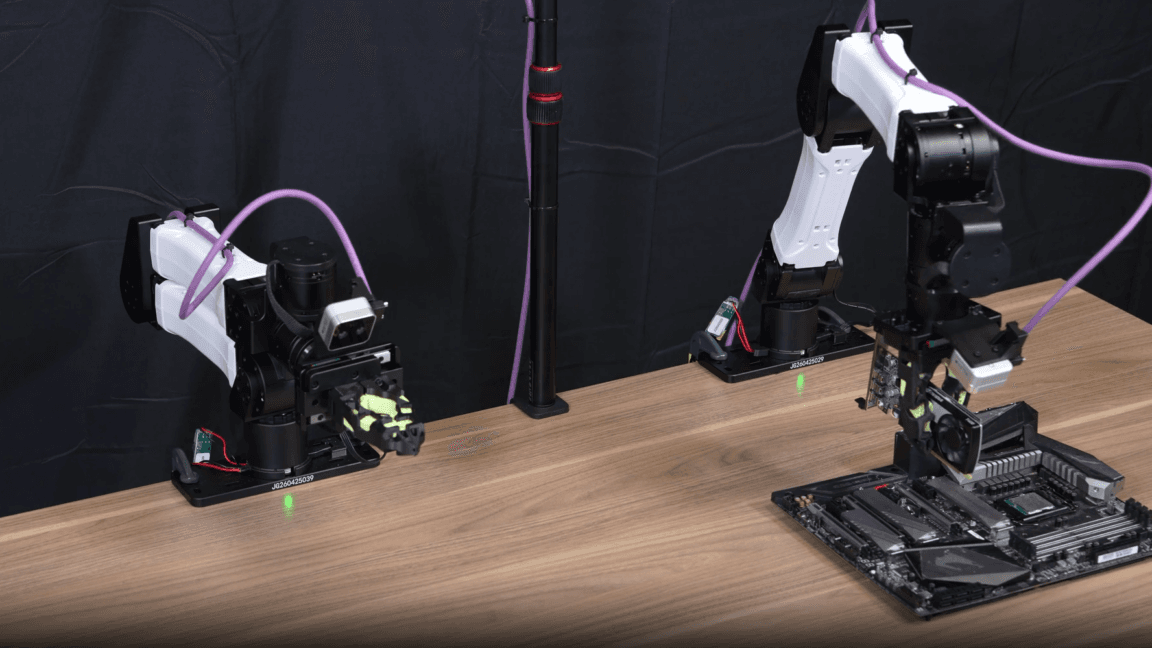
Artificial intelligence has already transformed how software is written, designs are created, and data is analyzed. Now, it is beginning to reshape how robots learn. In a striking new development from NVIDIA's GEAR lab and its academic partners, AI coding agents have been given control of a real robotics lab — and the results are turning heads across the tech and robotics industries. These agents autonomously designed training regimens that taught robotic arms to cut zip ties and insert GPUs into tight motherboard slots, two tasks that require a surprising degree of physical precision and adaptability.
This is not a controlled demo with hand-crafted scripts. This is fully autonomous AI-driven robot training, running overnight, with human researchers simply reading the reports in the morning.
What Is ENPIRE and Why Does It Matter?
At the center of this breakthrough is a new software framework called ENPIRE — an agent harness developed by researchers at NVIDIA's Generalist Embodied Agent Research (GEAR) lab, in collaboration with Carnegie Mellon University and the University of California, Berkeley.
An agent harness, for those unfamiliar with the term, is software that wraps around an AI model and equips it with the tools and structure it needs to act autonomously in the real world. ENPIRE specifically provides AI coding agents with capabilities including memory, context management, constraint handling, and feedback loops. These features allow an agent to not just generate code but to observe outcomes, adjust its approach, and iteratively improve — much like a human engineer refining a training program through trial and error.
What makes ENPIRE particularly significant is that it connects these AI agents directly to physical robotic systems and compute resources. The agents are not operating in a simulation. They are issuing instructions to real robotic arms in a real lab, measuring results, and updating their strategies accordingly.
The Tasks: GPU Installation and Zip Tie Cutting
The two demonstration tasks chosen by the NVIDIA GEAR team are deceptively simple to describe but technically demanding to execute with a robotic arm.
Inserting a GPU into a Motherboard
Installing a graphics card into a PCIe slot requires precise alignment, controlled force, and the ability to detect the satisfying click that confirms a secure connection. For a human, this is a routine task. For a robot, it demands fine motor control, accurate spatial reasoning, and real-time force feedback. The AI coding agents, given a generous token budget and access to the robotic systems, were able to develop a training regimen that enabled robots to perform this insertion reliably — a meaningful step toward automated hardware assembly.
Cutting Zip Ties
While cutting a zip tie may sound trivial, the challenge lies in locating the tie, positioning the cutting tool with enough precision to sever it cleanly, and applying the right amount of force without damaging surrounding components. This kind of manipulation task is exactly the sort of thing that has historically required extensive hand-engineered programming. The fact that an AI agent independently designed a training sequence capable of teaching this skill underscores just how far autonomous robot learning has come.
Self-Improving Robots: A New Era for Autonomous Systems
Jim Fan, NVIDIA's Director of AI and a key figure at the GEAR lab, captured the significance of this development in a LinkedIn post with a memorable line: "A part of our NVIDIA GEAR lab now self-improves tirelessly overnight. We just read the reports in the morning."
That statement carries enormous implications. The traditional pipeline for teaching robots new skills involves human robotics engineers spending days or weeks designing reward functions, writing control code, running experiments, interpreting failures, and iterating. With ENPIRE, that loop is being handed off — at least in part — to AI agents that can execute it autonomously, at scale, and without fatigue.
This is the promise of generalist embodied AI: robots that are not locked into narrow, pre-programmed behaviors but can continuously expand their capabilities through autonomous learning cycles driven by intelligent software agents.
The Role of Carnegie Mellon and UC Berkeley
The collaboration behind ENPIRE reflects the kind of academic-industry partnership that tends to produce durable, foundational advances. Carnegie Mellon University has long been a global leader in robotics research, and UC Berkeley's work in reinforcement learning and robot learning is equally well regarded. By combining NVIDIA's hardware expertise and the computational muscle of its GPU infrastructure with the academic rigor of these institutions, the ENPIRE project sits at a genuinely powerful intersection of applied and theoretical robotics research.
What This Means for the Future of Robotics and AI
The implications of frameworks like ENPIRE stretch well beyond a single lab in Santa Clara. Consider the following potential applications:
- Manufacturing and assembly lines where robots need to learn new component configurations without months of reprogramming.
- Data center maintenance, where hardware installation and management tasks could eventually be handled by robotic systems trained autonomously on-site.
- Logistics and warehousing, where robots must adapt to constantly changing inventories and packaging formats.
- Healthcare and laboratory settings, where precise manipulation of delicate instruments or samples is required.
In each of these domains, the ability to autonomously generate and refine robot training programs could dramatically reduce deployment timelines and lower the cost of introducing robotic automation. The key enabler in every case is the same: an intelligent agent harness that closes the feedback loop between a robot's actions and the AI system designing its training.
Challenges and the Road Ahead
Despite the excitement surrounding ENPIRE, it is important to acknowledge that fully autonomous robot training at industrial scale still faces significant hurdles. AI agents can make systematic errors that compound over time, and without careful human oversight, a training regimen that appears effective in one context may fail unpredictably in another. Safety constraints, interpretability of agent decisions, and robustness across diverse environments remain active areas of research.
Nevertheless, demonstrations like this one signal a clear directional shift. The question is no longer whether AI can help train robots — it clearly can. The question now is how quickly researchers and engineers can refine these frameworks to make them reliable, scalable, and safe enough for deployment beyond the research lab.
Conclusion: The Morning Report Revolution
The image of NVIDIA researchers arriving at work each morning to read reports generated by AI agents that trained robots through the night is a vivid snapshot of where automation is headed. ENPIRE represents a genuine leap forward in the autonomy of robotic learning systems, and the tasks it has already enabled — GPU installation, zip tie cutting — are only the beginning. As agent harness frameworks mature and AI models grow more capable, the range of skills robots can acquire autonomously will expand rapidly, bringing the era of truly generalist robotic systems closer than many might expect.