
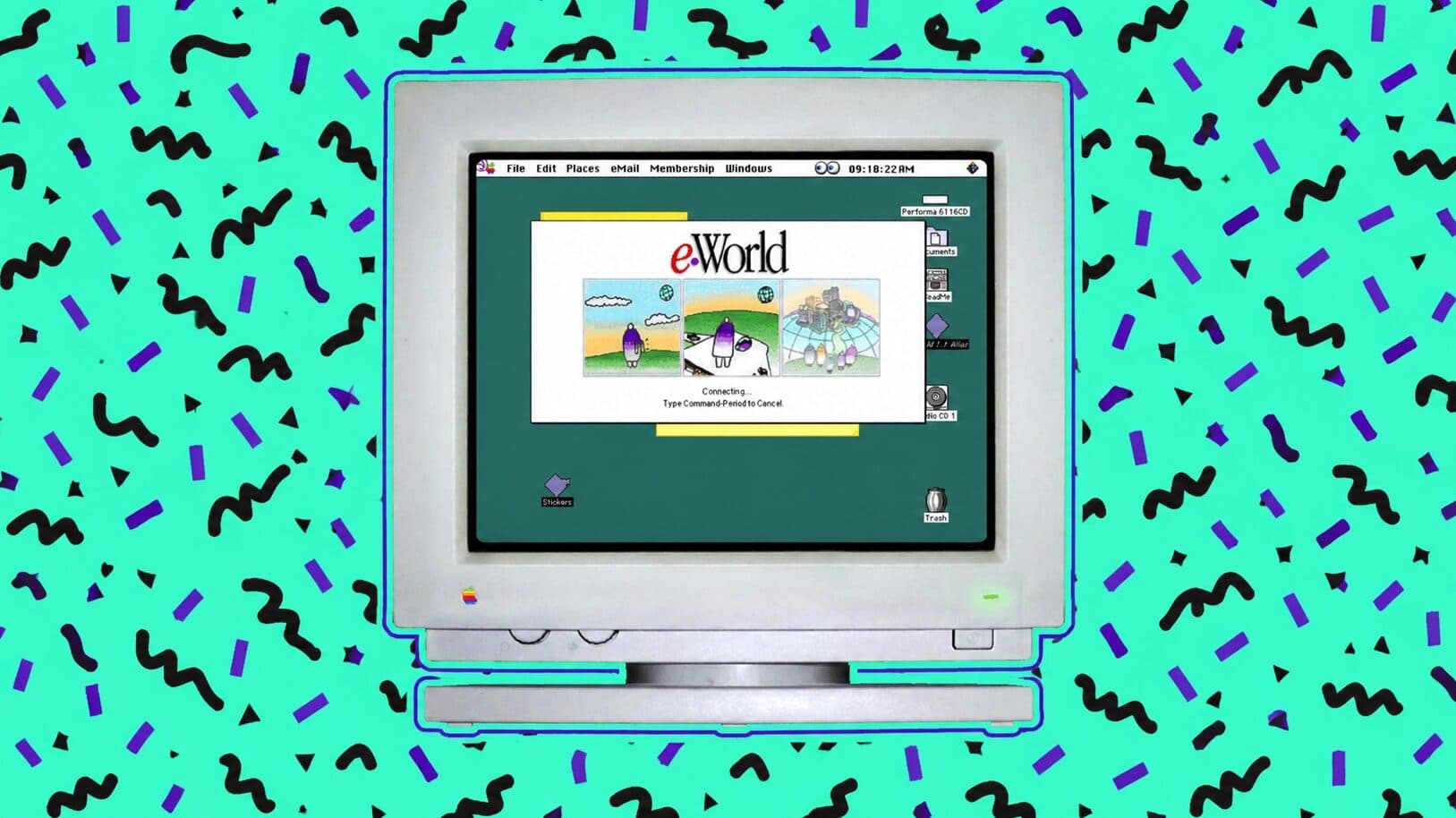
Apple eWorld: The Forgotten Online Service That Almost Changed the Internet
On June 20, 1994, Apple Computer launched one of its most ambitious and least remembered products: eWorld, a proprietary online service built exclusively for Macintosh users. Designed to compete directly with America Online (AOL) and other early internet services of the era, eWorld represented Apple's bold vision for what connected computing could look like — long before the modern web took over. Though it only lasted two years before being quietly shut down in 1996, the story of Apple eWorld is a fascinating chapter in the history of both Apple and the early internet.
What Was Apple eWorld?
Apple eWorld was a subscription-based online service that gave Mac users access to email, news, shopping, technical support, and community forums — all wrapped inside a uniquely Apple-designed graphical interface. Rather than presenting users with plain text menus like many competing services of the time, eWorld greeted subscribers with a colorful, illustrated virtual town. Users navigated the service by clicking on animated buildings that represented different categories of content, such as a "post office" for email, a "newsstand" for news, and a "community center" for message boards and chat.
This town-map metaphor was deeply characteristic of Apple's design philosophy in the early 1990s. At a time when most online services were text-heavy and intimidating to newcomers, eWorld aimed to be immediately intuitive and visually inviting. It was a graphical user interface applied to the online world — a natural extension of what the Macintosh had done for personal computing a decade earlier.
The Technology Behind eWorld
Apple did not build eWorld entirely from scratch. The service was developed in partnership with America Online, which supplied much of the underlying network infrastructure. This made for an unusual arrangement: Apple was simultaneously a partner with AOL and a direct competitor to it in the online services market. The eWorld client software ran exclusively on the Mac, requiring at least System 7 and a modem connection, and was distributed on floppy disks or CD-ROM.
Subscribers paid a monthly fee for a set number of hours of access, with additional hourly charges beyond that limit — a billing structure that was standard across the online service industry at the time. This model would later become a point of frustration for users as flat-rate and then unlimited internet access became the norm.
How eWorld Compared to AOL and CompuServe
The mid-1990s were a fiercely competitive time for online services. AOL, CompuServe, Prodigy, and The Microsoft Network were all fighting for subscribers, spending enormous sums on marketing and mailing out millions of free trial disks. Against this backdrop, eWorld faced an immediate and obvious limitation: it was exclusively available to Mac users.
In 1994, the Mac, despite its devoted following, represented a relatively small portion of the personal computer market. Windows-based PCs were dominant, and the decision to lock eWorld to the Apple ecosystem meant the service was targeting a much smaller potential audience than its competitors. While AOL was growing at a staggering pace and signing up millions of subscribers across multiple platforms, eWorld was working with a ceiling baked into its very concept.
That said, eWorld had genuine strengths. Its interface was widely praised as more elegant and user-friendly than AOL's. Apple's involvement ensured that technical support content was robust and authoritative, making it particularly valuable for Mac owners who needed help troubleshooting their computers. The community forums attracted a passionate group of Apple enthusiasts who appreciated having a dedicated online home.
The Rise and Fall of eWorld
Despite its charms, eWorld struggled to gain critical mass. Subscriber numbers never approached those of AOL, and the service never managed to attract the broad range of content partnerships and commercial offerings that made competing platforms more compelling. Apple, facing serious financial difficulties throughout the mid-1990s, was not in a position to sustain the investment required to make eWorld a serious long-term competitor.
The broader internet landscape was also shifting rapidly. The World Wide Web was exploding in popularity, web browsers like Netscape Navigator were becoming mainstream tools, and the idea of a proprietary, walled-garden online service was already beginning to look dated. Users increasingly wanted open access to the entire internet rather than a curated selection of content provided by a single company.
On March 31, 1996, Apple shut down eWorld for good. The service had been live for less than two years. Users were encouraged to transition to other internet providers, and the colorful virtual town was switched off forever.
Why Apple eWorld Still Matters Today
Looking back at Apple eWorld from a modern perspective, it is tempting to see it simply as a failed product. But that reading misses what makes it genuinely interesting to students of Apple history and internet history alike.
- eWorld demonstrated Apple's instinct for designing technology around human experience and visual metaphor — an instinct that would eventually produce the iMac, the iPhone, and the App Store.
- Its town-map interface was a remarkably early example of what we might today call UX-first thinking, prioritizing the experience of the user over the raw functionality of the technology.
- The service's failure highlighted a lesson Apple would take to heart: ecosystems matter, and a product limited to Mac users alone faced structural disadvantages in a Windows-dominated world — a challenge Apple addressed brilliantly with iTunes for Windows in 2003 and beyond.
- eWorld's reliance on a partner (AOL) for core infrastructure while competing against that same partner in the market foreshadowed many complex platform relationships that define the tech industry today.
Apple eWorld may have been short-lived, but its ambitions were anything but small. It was an early attempt to create a seamless, beautiful, branded digital universe for Apple customers — an idea that, in many ways, Apple never truly abandoned. Every time you open the App Store, iCloud, or Apple News, you are experiencing the philosophical descendants of that colorful virtual town that went live on June 20, 1994.
A Footnote That Deserves More Attention
Most histories of Apple skip lightly over eWorld, focusing instead on the drama of Steve Jobs' departure, the Newton's rise and fall, or the near-bankruptcy of the mid-1990s. But eWorld stands as a reminder that Apple has always thought beyond the hardware — always imagined that its devices were portals to something bigger, richer, and more connected. The execution was imperfect and the timing was difficult, but the vision was genuine. In an era when the internet was still finding its shape, Apple tried to put its own stamp on what online life could look like. That effort, however brief, is well worth remembering.