
NASA's Most Daring Satellite Rescue Mission Is Racing Against Time
In the high-stakes world of space exploration, few challenges are as complex — or as urgent — as saving a failing satellite already in orbit. Yet that is precisely what NASA has set out to do. With a $500 million astronomy mission at risk of plunging back into Earth's atmosphere, the space agency turned to an ambitious startup and issued what may be one of the most demanding contracts in recent aerospace history: build, test, and launch a rescue spacecraft in under a year. The clock is ticking, and the scientific community is watching closely.
What Is the Swift Telescope and Why Does It Need Saving?
The Neil Gehrels Swift Observatory, known simply as Swift, has been one of NASA's most productive space telescopes since its launch in 2004. Designed to detect gamma-ray bursts — the most energetic explosions in the universe — Swift has contributed to thousands of scientific papers and helped astronomers understand some of the cosmos's most violent phenomena. It has also played a critical role in observing everything from black holes to distant supernovae.
However, after more than two decades in orbit, Swift's altitude has gradually decayed to a point where, without intervention, the spacecraft is projected to reenter Earth's atmosphere and be destroyed. That would mean the loss of not just a functioning observatory, but also the irreplaceable scientific infrastructure it represents. For NASA's astrophysics division, losing Swift prematurely was simply not an option.
The Record-Breaking Challenge NASA Put on the Table
In August of last year, NASA approached three companies with an extraordinary proposition: could any of them build and launch a satellite to intercept Swift, latch onto it, and boost it back to a safe operating altitude — all in less than a year and within a tight budget? The timeline alone would have made most established aerospace contractors pause. Building and launching any satellite typically takes years of planning, engineering, and testing. Doing it in under twelve months for a live orbital rescue operation was something nobody had ever attempted before.
Shawn Domagal-Goldman, director of NASA's astrophysics division, described the moment one company rose to the occasion: "They came back with a response that was technically and programmatically plausible, and then we were like, 'Yeah, let's do it.'" That company was Katalyst Space Technologies.
Who Is Katalyst Space Technologies?
Founded in 2020, Katalyst Space Technologies is a relatively young startup in the commercial space sector, but one that has built its identity around a concept that is rapidly gaining traction in the industry: on-orbit satellite servicing. Rather than simply building new satellites, Katalyst has focused on developing the technology needed to extend the life of existing spacecraft — refueling them, repositioning them, or in this case, physically rescuing them from orbital decay.
Despite being only a few years old, Katalyst presented the most compelling solution among the three companies NASA consulted. Their proposal was technically sound, operationally feasible within the compressed timeline, and matched the budgetary constraints NASA had set. In September, NASA awarded Katalyst a $30 million contract to make it happen.
How the Rescue Mission Actually Works
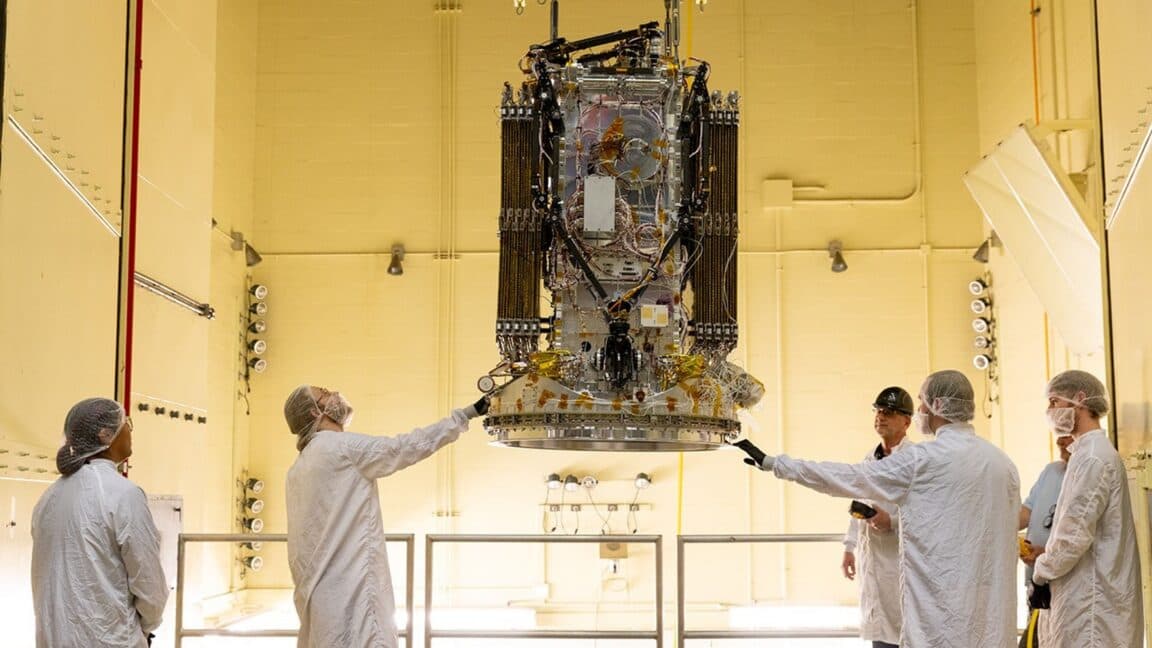
The plan centers on a small spacecraft called Link — Katalyst's purpose-built servicing vehicle. Link will be launched into orbit with one critical mission: chase down the Swift telescope, which is itself a moving target traveling at orbital velocities of thousands of miles per hour, and physically connect with it.
To achieve that connection, Link is equipped with three robotic arms designed to latch onto Swift's exterior. Once a secure grip is established, Link will fire its own propulsion system to gradually raise Swift's orbit, pushing it back up to a safe operating altitude where it can continue its scientific observations for additional years.
The technical challenges involved are formidable. Rendezvous and proximity operations — the process of navigating one spacecraft to meet another in orbit — require extraordinarily precise maneuvering. Latching onto a satellite that was never designed to be serviced adds another layer of complexity. Swift has no dedicated docking port, meaning Katalyst's robotic arms must grip the existing structure of the spacecraft without damaging its sensitive instruments or systems.
Why This Mission Matters Beyond Swift
While the immediate goal is saving one telescope, the broader implications of this mission extend far into the future of space operations. If Katalyst's Link spacecraft successfully completes the rescue, it will demonstrate that on-orbit servicing is a viable, scalable solution for extending the life of aging satellites — not just for NASA, but for commercial operators and other government agencies as well.
The global satellite fleet includes hundreds of spacecraft operating well beyond their originally planned lifespans, many of them at risk from fuel depletion or orbital decay. A proven rescue and servicing capability could fundamentally change how the space industry thinks about satellite lifecycle management, reducing costs and reducing space debris by keeping functional hardware operational longer.
The Stakes of an Unprecedented Timeline
Perhaps the most remarkable aspect of this mission is the speed at which it has come together. From NASA's initial inquiry in August to a signed contract in September, and with a launch window constrained by Swift's continuing orbital descent, Katalyst's team has had virtually no margin for error. Every phase of development — design, fabrication, testing, and launch preparation — has had to proceed in parallel rather than sequentially, as is standard in most aerospace programs.
This compressed schedule reflects a broader shift in how NASA and the commercial sector are beginning to approach space missions. New Space companies, unburdened by legacy procurement processes, are demonstrating that ambitious goals can sometimes be achieved faster and more affordably than traditional timelines suggest. Whether Katalyst can deliver on that promise under the ultimate real-world pressure remains to be seen.
Will the Mission Succeed?
As of now, the mission is progressing, but the hardest part — the actual rendezvous, capture, and orbit-raising maneuver — still lies ahead. The space community is cautiously optimistic. NASA's willingness to take this bet on a young company speaks volumes about both the urgency of saving Swift and the growing confidence in the commercial space sector's capabilities.
If Link succeeds, it will mark a historic first: the first time a commercial servicing spacecraft has rescued a government science mission from orbital decay. For Katalyst, for NASA, and for the future of sustainable space operations, the stakes could hardly be higher. The universe, after all, still has a great deal left to teach us — and Swift may yet have many more years of science ahead of it.