
NASA's Most Ambitious Satellite Rescue Mission: A Race Against Gravity
In the fast-moving world of space exploration, urgency is rarely a stranger. But even by NASA's standards, what happened in August of last year was extraordinary. The agency approached three companies with an almost impossible challenge: design, build, test, and launch a satellite capable of rescuing another satellite—one already falling toward a fiery end in Earth's atmosphere—in less than a year, on a shoestring budget. The mission, if successful, would mark a historic first in the history of orbital spacecraft servicing.
The target? The Neil Gehrels Swift Observatory, a beloved astrophysics satellite valued at approximately $500 million. The solution? A scrappy aerospace startup called Katalyst Space Technologies, founded just a few years prior, with an audacious plan and the technical credibility to back it up.
What Is the Swift Observatory and Why Does It Matter?
Launched in 2004, the Neil Gehrels Swift Observatory has spent two decades watching the sky for gamma-ray bursts—some of the most violent and energetic events in the known universe. Swift has been instrumental in advancing our understanding of black holes, neutron stars, and the deaths of massive stars. Its observations have contributed to hundreds of peer-reviewed scientific papers and have helped astronomers piece together some of the cosmos's most dramatic stories.
But Swift is aging, and its orbit has been gradually decaying. Without intervention, the spacecraft would eventually succumb to atmospheric drag, re-entering Earth's atmosphere and burning up—taking with it a uniquely capable scientific instrument that no current satellite can fully replace. Losing Swift would represent not just a financial loss, but a significant setback for the global astrophysics community.
That is precisely why NASA began scrambling for options, and why the resulting rescue plan is drawing attention from across the aerospace industry.
Enter Katalyst Space Technologies
When NASA issued its rapid-response call to industry last August, three companies answered. But it was Katalyst Space Technologies—a startup founded in 2020 and still finding its footing in a highly competitive market—that presented what NASA described as the most technically and programmatically plausible solution.
"They came back with a response that was technically and programmatically plausible, and then we were like, 'Yeah, let's do it,'" said Shawn Domagal-Goldman, director of NASA's astrophysics division.
That confidence translated quickly into action. In September, NASA awarded Katalyst a $30 million contract—a remarkably lean budget for a mission of this complexity—to build, test, and launch a small satellite designed to rendezvous with Swift in orbit. The timeline was even leaner: the entire project, from contract award to launch, was expected to take less than a year.
How the Rescue Mission Works: The Link Spacecraft Explained
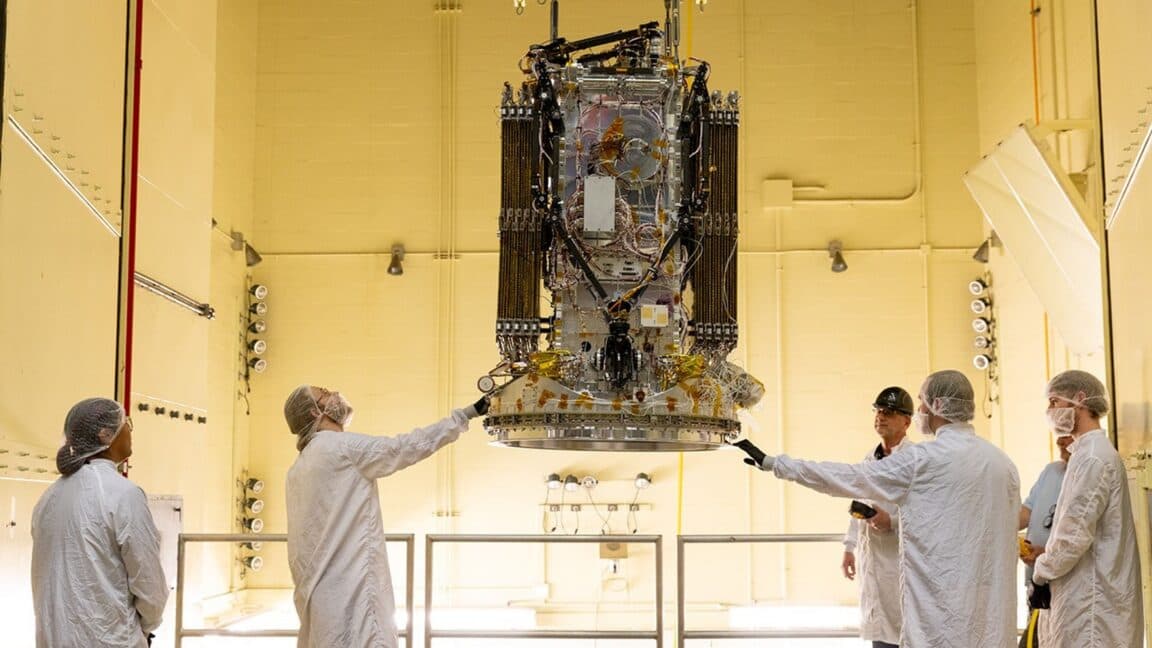
Katalyst's solution centers on a spacecraft called Link, a compact but sophisticated servicing vehicle engineered specifically for this mission. The plan involves several technically demanding steps, each of which has never been attempted in quite this way before.
- Rendezvous and approach: Link must autonomously chase down the Swift observatory in orbit, matching its speed and trajectory with extraordinary precision.
- Capture via robotic arms: The spacecraft is equipped with three robotic arms designed to latch onto Swift's exterior—a spacecraft that was never designed to be serviced or physically grappled by another vehicle.
- Orbital reboost: Once securely attached, Link will fire its thrusters to push Swift's orbit back to a safe operating altitude, effectively extending the telescope's operational lifespan by several years.
If Link succeeds, Swift can resume its scientific observations, continuing to gather data that astronomers worldwide depend on. If something goes wrong at any stage—during capture, docking, or the reboost burn—the mission could fail, potentially accelerating Swift's demise or leaving Link stranded in orbit.
Why This Mission Is Unprecedented
Satellite servicing is not a new concept. NASA's astronauts famously repaired the Hubble Space Telescope multiple times using crewed Space Shuttle missions. But performing autonomous robotic servicing on a satellite that was never designed to be serviced—without a human in the loop and on a compressed development timeline—is a fundamentally different challenge.
Most servicing missions to date have involved satellites equipped with special docking interfaces or grapple fixtures. Swift has none of these. Katalyst's engineering team has had to develop novel approaches for capture and stabilization, working under time pressure that would make most aerospace veterans uncomfortable. The fact that they reached the launch pad at all is, by any measure, a significant achievement.
What's at Stake for the Future of Space Servicing
Beyond Swift's fate, this mission carries enormous implications for the broader concept of satellite servicing and life extension. There are hundreds of operational satellites in orbit right now that will eventually face the same problem Swift is facing—gradual orbital decay, fuel exhaustion, or component failure. A proven, cost-effective method for rescuing or extending these assets could save governments and commercial operators billions of dollars over the coming decades.
If Katalyst's Link spacecraft succeeds, it could serve as a proof of concept that accelerates investment in the nascent satellite servicing industry. It could also demonstrate that small, agile aerospace startups are capable of executing high-stakes missions that traditionally required the resources of major defense contractors or national space agencies.
A Defining Moment for Commercial Space
The mission launched from Wallops Island, Virginia, a reminder that transformative space achievements don't always originate from the largest launchpads or the biggest budgets. What Katalyst Space Technologies has attempted in under a year—with $30 million and a small but determined team—is the kind of story that defines the new era of commercial space exploration.
Whether Link successfully captures Swift and restores it to a safe orbit remains to be seen. But the attempt itself has already pushed the boundaries of what is considered possible in modern spacecraft engineering. The world is watching, and the astrophysics community is holding its breath.