
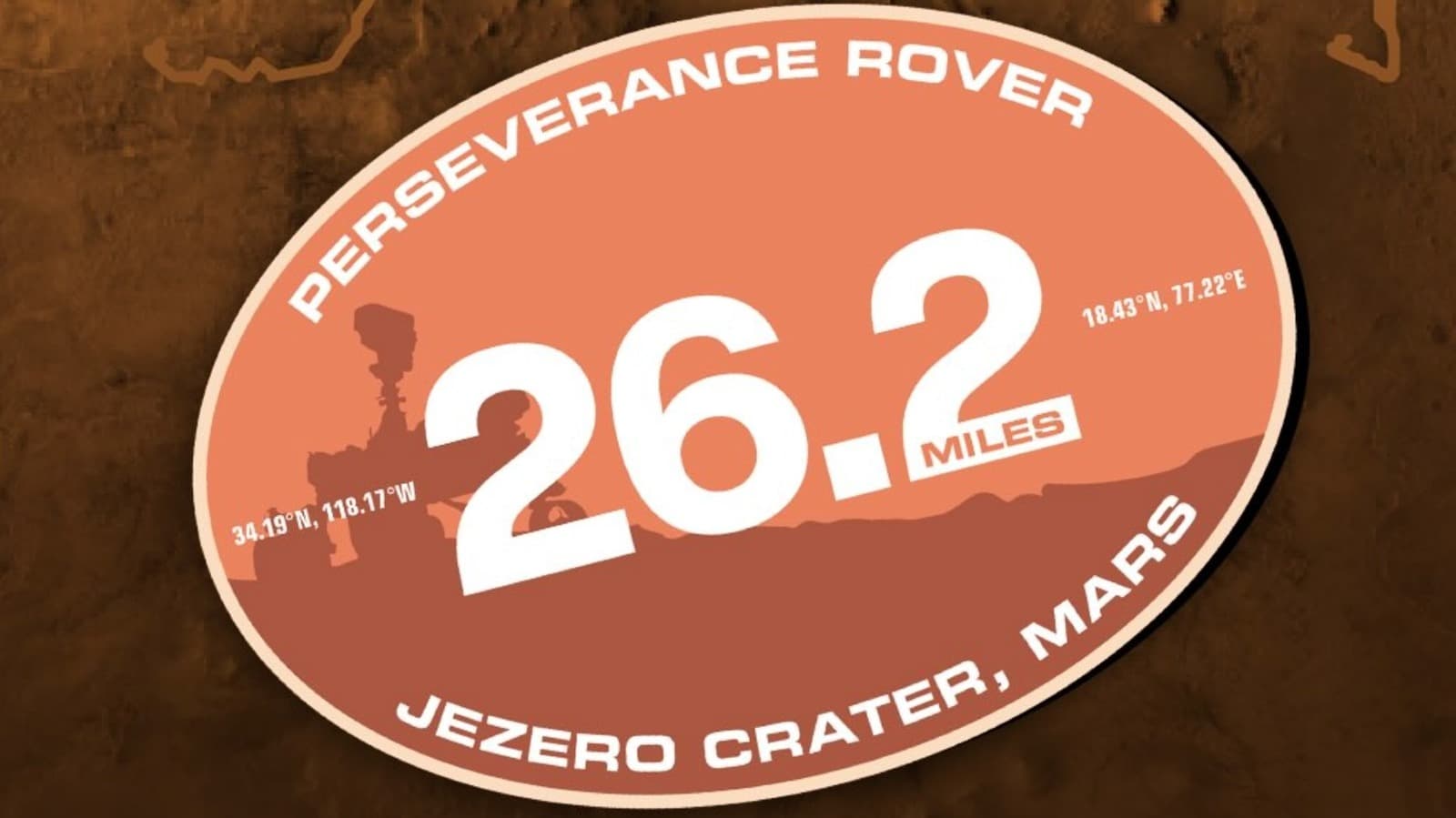
NASA's Perseverance Rover Completes a Marathon on Mars — Here's Why That's Extraordinary
In the world of long-distance running, completing a marathon — 26.2 miles — is considered one of the greatest physical achievements a human being can accomplish. It demands months of training, peak physical conditioning, and an iron will to push through exhaustion and pain. Now imagine doing all of that not on Earth, but on the rust-colored, crater-scarred surface of Mars, where dust storms erupt without warning, temperatures plunge to minus 80 degrees Fahrenheit, and the terrain is littered with ancient rocks and treacherous inclines. That's exactly what NASA's Perseverance rover has accomplished — and it did so in just five years.
This remarkable milestone marks a major achievement not only for NASA's Mars exploration program but for humanity's broader ambition to understand and eventually reach our neighboring planet. Since its landing in Jezero Crater on February 18, 2021, Perseverance has become one of the most productive and celebrated robotic explorers ever sent into the cosmos.
The Journey So Far: From Landing to Marathon Milestone
Perseverance touched down on Mars after a nail-biting "Seven Minutes of Terror" entry, descent, and landing sequence that the NASA team executed flawlessly. The rover landed in Jezero Crater, a site scientists believe was once an ancient lake bed and river delta — a prime location for searching for signs of ancient microbial life.
In the years since landing, Perseverance has navigated some of the most challenging terrain ever explored by a robotic vehicle. Rocky outcroppings, ancient river channels, steep crater rims, and fields of sharp debris have all stood between the rover and its scientific objectives. Yet kilometer by kilometer, Perseverance pressed on, guided by a team of engineers and scientists at NASA's Jet Propulsion Laboratory (JPL) in Pasadena, California.
Reaching the equivalent of a marathon distance — roughly 42.195 kilometers — places Perseverance in elite company among Mars rovers. Its predecessor, Opportunity, famously traveled over 45 kilometers during its 15-year mission, setting the all-time Mars distance record. The fact that Perseverance has approached that benchmark in just five years speaks to the aggressive and ambitious science campaign it has been executing.
What Has Perseverance Been Doing Along the Way?
Distance alone doesn't tell the full story. Every meter Perseverance has driven has been in service of groundbreaking science. Here are some of the most significant accomplishments the rover has achieved during its marathon journey across the Martian surface:
- Rock sample collection: Perseverance is the first Mars rover designed specifically to collect and cache rock and regolith samples for potential return to Earth. To date, it has collected dozens of carefully selected samples that scientists believe could hold ancient biosignatures — chemical or physical evidence of past life.
- Oxygen production: The rover carries the MOXIE (Mars Oxygen In-Situ Resource Utilization Experiment) instrument, which has successfully produced oxygen from the Martian atmosphere. This technology is a critical step toward supporting future human missions to Mars.
- Atmospheric data: Through its suite of sensors, including the MEDA (Mars Environmental Dynamics Analyzer) instrument, Perseverance has gathered invaluable data on Martian weather patterns, dust activity, radiation levels, and atmospheric composition.
- Imaging the Martian landscape: Equipped with 23 cameras, Perseverance has sent back millions of high-resolution images and video footage of Mars, including the first-ever audio recordings of the Martian wind and surface sounds.
- Supporting Ingenuity helicopter flights: Perseverance served as the base station and communications relay for Ingenuity, the small helicopter that made history as the first powered, controlled flight on another planet — completing more than 70 flights before ending its mission.
Why the Marathon Distance Milestone Matters for Future Mars Exploration
Celebrating a distance milestone might seem like a novelty, but it carries genuine scientific and engineering significance. The more ground Perseverance covers, the more geological diversity it can sample. Mars is a planet with a complex and layered history, and different regions preserve different chapters of that story. By traveling farther, the rover increases the statistical likelihood of finding compelling evidence — or ruling out the possibility — of ancient life in Jezero Crater.
From an engineering standpoint, the marathon milestone validates the durability and reliability of the rover's systems. Perseverance's wheels, motors, navigation software, and power systems have all performed under conditions that would destroy most Earth-based machinery. The lessons learned from operating Perseverance will directly inform the design of future robotic and crewed missions to the Red Planet.
The Road Ahead: What Comes Next for Perseverance?
NASA has no intention of slowing Perseverance down. The rover continues to push toward new scientific targets along the ancient delta region and the rim of Jezero Crater, where some of the oldest and most geologically interesting rock formations on Mars are waiting to be studied. Scientists are particularly eager to analyze rock layers that may have been deposited in water over three billion years ago.
Looking further ahead, NASA and the European Space Agency (ESA) are collaborating on the Mars Sample Return mission, which aims to retrieve the sample tubes Perseverance has been caching and bring them back to Earth for analysis in laboratories far more powerful than anything that can be sent to Mars. If successful, it would represent the most significant scientific achievement in planetary science history.
A Symbol of Human Curiosity and Perseverance
There is something deeply poetic about a rover named Perseverance completing a marathon on another planet. The name was chosen by a middle school student through a nationwide NASA contest, and it has proven to be perfectly fitting. Like the runners who push through the infamous "wall" at mile 20 of a marathon, Perseverance has faced seemingly insurmountable obstacles — brutal terrain, extreme temperatures, and the vast loneliness of space — and kept moving forward.
In an era when much of the news feels heavy and uncertain, the quiet, steady progress of a six-wheeled robot on a distant world serves as a reminder of what human ingenuity and determination can achieve. Perseverance's marathon is not just a technical milestone — it is a testament to the enduring human desire to explore, to question, and to reach beyond the horizon.
The Red Planet, it turns out, has a lot more road left to travel — and Perseverance shows no signs of stopping.