
The Quantum Computing Breakthrough Everyone Is Talking About
For years, quantum computing has lived comfortably in the realm of "the future." Researchers, investors, and tech enthusiasts have been told to expect transformative, real-world quantum applications somewhere between five and ten years away — a horizon that always seemed to stay just out of reach. But a wave of announcements in mid-2025 is beginning to reshape that narrative in a significant way. Among the most striking claims: genuinely useful, error-corrected quantum computing could arrive as soon as 2028.
That is not a typo. 2028 — a date that is, at the time of this writing, fewer than three years away. If the promise holds, it would represent one of the most dramatic accelerations in the history of computing technology. To understand why this claim is so significant, it helps to understand the central problem that has held quantum computing back: errors.
Why Quantum Errors Are Such a Big Deal
Classical computers store information as bits — values that are either 0 or 1. Quantum computers use qubits, which can exist in a superposition of both states simultaneously. This property is what gives quantum computers their theoretical power, enabling them to solve certain classes of problems exponentially faster than any classical machine.
The catch is that qubits are extraordinarily fragile. They are highly sensitive to environmental interference — heat, vibration, electromagnetic noise — and errors accumulate rapidly during computation. On today's hardware, qubits are considered "noisy," meaning the results they produce are prone to mistakes that compound over the course of a calculation. For short, simple computations, this may be manageable. For the complex, meaningful problems where quantum computing promises to shine — drug discovery, materials science, cryptography, climate modeling — noisy hardware simply is not good enough.
This is precisely why error correction is considered the pivotal challenge in the field.
What Is Quantum Error Correction and How Do Logical Qubits Work?
Quantum error correction addresses the noise problem by grouping multiple physical qubits together to form what is called a logical qubit. Rather than relying on a single fragile qubit to store and process information, a logical qubit encodes that information redundantly across several physical qubits. Additional neighboring qubits — called ancilla qubits — are regularly measured to detect when an error has occurred and to identify its nature, allowing the system to apply a correction before the error propagates.
Think of it like a distributed backup system for quantum information. If one physical qubit in the group misbehaves, the others can vote it out and correct the record. The logical qubit, as a whole, remains reliable even as individual physical qubits make mistakes.
The tradeoff is resource intensity. Depending on the error correction scheme used, building a single reliable logical qubit can require dozens or even hundreds of physical qubits. Scaling this up to a machine capable of running complex real-world algorithms demands enormous numbers of high-quality physical qubits — which is exactly why most experts have been cautious about timelines.
The 2028 Promise: Who Is Making It and Why It Matters
The promise of useful, error-corrected quantum computing by 2028 stands out sharply against the industry's usual projections. It suggests that at least one major player believes the engineering challenges involved — manufacturing enough high-quality qubits, implementing error correction at scale, and integrating the full software stack — can be solved within this decade, and soon.
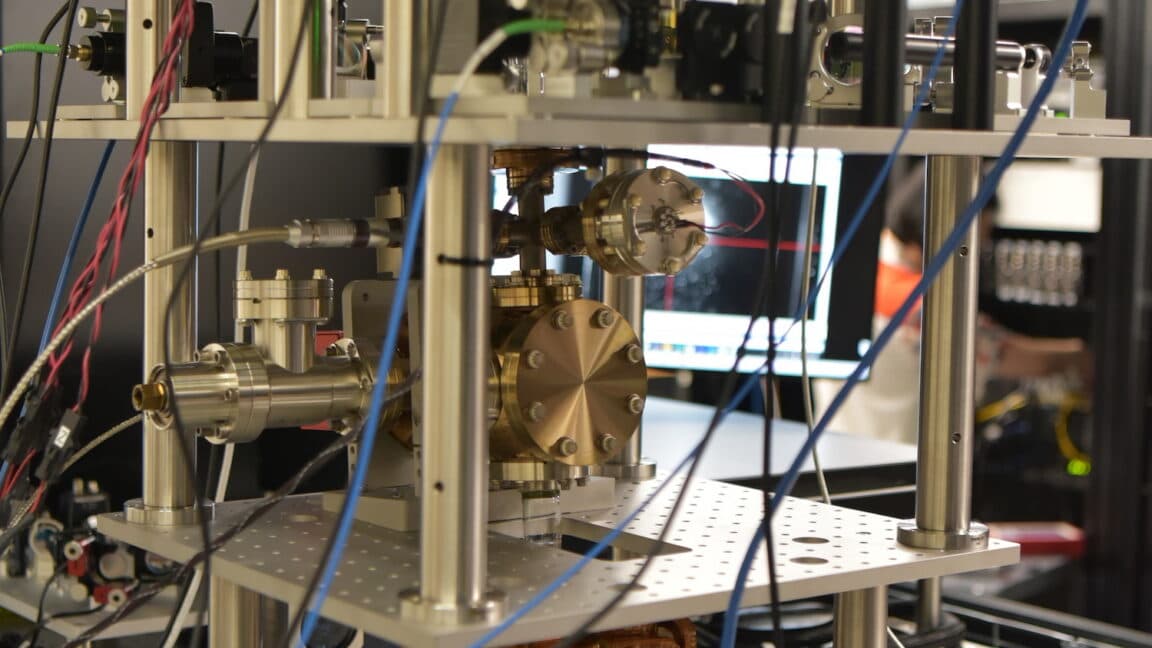
This type of claim has arrived alongside other meaningful announcements, including updated trapped ion processor technology and new benchmarking results. Trapped ion systems represent one of the leading hardware approaches in quantum computing. In these systems, individual ions are held in place using electromagnetic fields and manipulated with laser pulses to perform quantum operations. They offer some of the highest qubit fidelity rates currently available, making them a strong candidate for error-corrected architectures.
Quantum Supremacy Claims Are Being Revised — And That Is a Good Sign
Interestingly, this wave of announcements also includes a note of intellectual humility. Some earlier claims of "quantum supremacy" — the point at which a quantum computer performs a task that no classical computer could complete in a reasonable time — have been walked back. This happened not because quantum hardware underperformed, but because advances in classical algorithms narrowed the gap.
Far from being discouraging, this is actually a sign of scientific health. It means the broader computing field is competitive and rigorous, and that quantum milestones are being held to a high standard. Benchmarks that survive this scrutiny will be far more credible and meaningful when they are eventually claimed.
What Would Useful Quantum Computing Actually Look Like?
When researchers talk about "useful" quantum computing, they mean machines that can solve practical problems that matter — problems classical computers cannot crack efficiently. The most anticipated applications include:
- Pharmaceutical research: Simulating molecular interactions at the quantum level to accelerate drug discovery and reduce the cost of clinical development.
- Materials science: Designing new materials with tailored properties, from superconductors to more efficient batteries for electric vehicles.
- Cryptography: Both breaking current encryption standards and enabling new, quantum-safe alternatives.
- Optimization problems: Solving complex logistical and financial optimization challenges far beyond the reach of today's computers.
- Climate modeling: Running highly accurate simulations of atmospheric chemistry and energy systems to better understand and address climate change.
None of these are achievable with today's noisy, error-prone hardware. All of them become possible — at least in principle — once reliable logical qubits exist at sufficient scale.
Should We Believe the 2028 Timeline?
Healthy skepticism remains warranted. The history of quantum computing is littered with bold predictions that slipped by years. Building error-corrected quantum computers at useful scale is a formidable engineering challenge, and unexpected obstacles have a habit of appearing as technology matures. Supply chain constraints, qubit fabrication challenges, software tooling gaps, and the sheer complexity of quantum control systems could all cause delays.
That said, the pace of progress in 2025 is genuinely different from prior years. Multiple hardware modalities — superconducting qubits, trapped ions, photonic systems, and neutral atoms — are advancing simultaneously. The field is attracting unprecedented investment, and the engineering talent working on these problems has grown substantially. The 2028 target may be ambitious, but it is no longer obviously unrealistic.
Looking Ahead: A Pivotal Few Years for Quantum Computing
Whether useful quantum error correction arrives in 2028, 2030, or 2032, the direction of travel is unmistakable. The field is converging on the milestone that separates theoretical promise from real-world impact. For businesses, researchers, and policymakers, the time to understand and prepare for quantum computing is not some vague future moment — it is now. The organizations that begin building quantum literacy and strategy today will be far better positioned to capitalize on this technology when it arrives. And based on the latest announcements, that arrival may come sooner than almost anyone expected.