
Rocket Report: Blue Origin's Launch Pad Rebuild, Relativity Space Eyes Mars, and the Road to Starship Flight 13
The pace of the global space launch industry shows no signs of slowing down. From infrastructure overhauls at established players to ambitious interplanetary goals from newer entrants, this week's Rocket Report is packed with developments that could shape the future of space exploration. Whether you're a seasoned space enthusiast or someone just beginning to follow the new era of rocketry, here's everything you need to know from the latest edition of the Rocket Report.
Starship Flight 13: What We Know So Far
Before diving into the main stories, it's worth addressing the question on every space fan's mind: when will SpaceX's Starship fly again? According to Gwynne Shotwell, SpaceX's president and chief operating officer, the next Starship test flight — officially designated Flight 13 — could happen as soon as next month. Shotwell shared this update in a recent interview with CNBC, offering one of the clearest timelines yet for the highly anticipated mission.
That said, there's still a significant amount of work to complete before Flight 13 is ready to lift off, so next month shouldn't be treated as a firm target. What Shotwell did confirm is that Flight 13 will closely resemble the previous flight, featuring a suborbital trajectory and a splashdown of the ship in the Indian Ocean. SpaceX is deliberately holding off on an orbital attempt until at least Flight 14, following a critical setback on the last mission when the ship failed to complete a crucial engine restart while in space. The company is taking a methodical, step-by-step approach to reaching full orbital capability — a philosophy that has defined much of SpaceX's iterative development strategy.
Blue Origin Begins Rebuilding Its Launch Pad
One of the bigger infrastructure stories making headlines this week involves Blue Origin, Jeff Bezos's rocket company, which has begun the process of rebuilding its launch pad following recent damage. While Blue Origin has operated somewhat in SpaceX's shadow in recent years, the company has been ramping up its ambitions considerably, particularly with its New Glenn heavy-lift rocket and its continued work on the BE-4 engines that also power United Launch Alliance's Vulcan Centaur.
A launch pad rebuild is never a minor undertaking. These structures must withstand enormous forces during liftoff — including intense heat, acoustic energy, and mechanical stress — and every component must be engineered to exacting tolerances. The fact that Blue Origin is actively rebuilding signals the company's commitment to maintaining a robust and reliable launch cadence going forward. As competition in the heavy-lift sector intensifies, having a fully operational and resilient launch infrastructure will be critical to Blue Origin's ability to compete for government and commercial contracts.
The rebuild effort also reflects a broader trend across the industry: launch providers are investing heavily in ground support infrastructure, recognizing that the bottleneck to frequent launches is often not the rocket itself but the pads, fueling systems, and processing facilities that support them.
Relativity Space Sets Its Sights on Mars
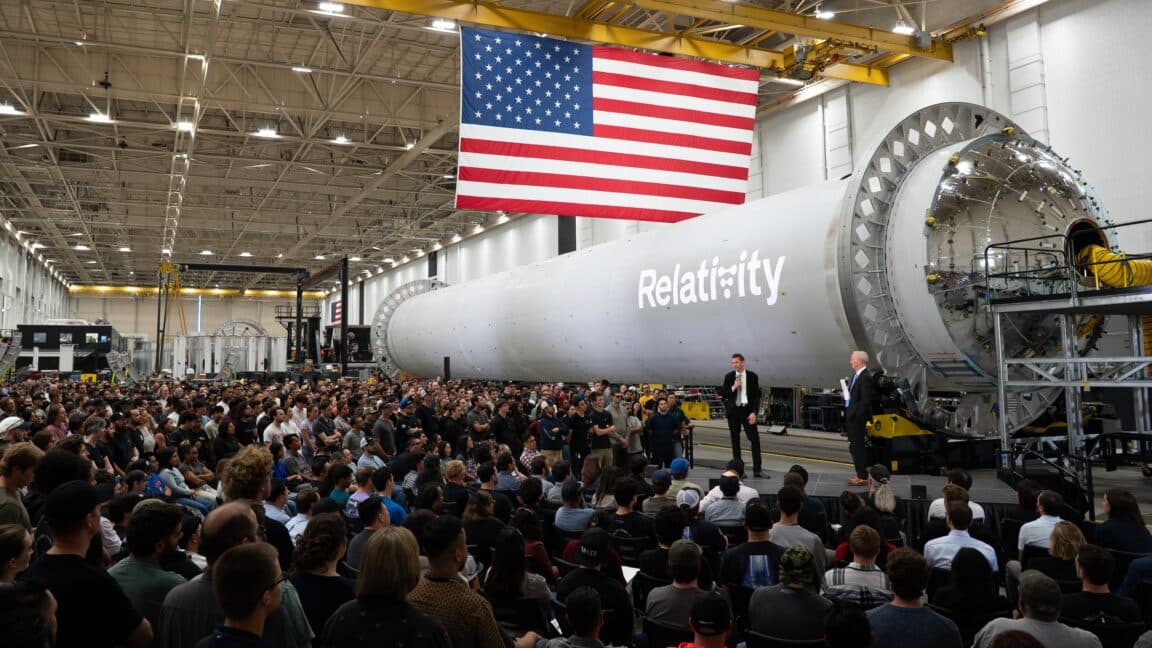
Perhaps the most forward-looking story in this week's report involves Relativity Space, the startup best known for its ambition to 3D-print an entire rocket. The company has recently signaled that its long-term vision extends well beyond Earth orbit — all the way to Mars. While Relativity has faced its own share of setbacks, including the failure of its Terran 1 rocket on its debut launch in 2023, the company has since pivoted toward developing its larger Terran R vehicle, a fully reusable rocket designed to compete with SpaceX's Falcon 9.
Targeting Mars is an extraordinarily bold goal for a company that has yet to achieve a successful orbital launch, but it speaks to the kind of long-horizon thinking that increasingly characterizes the new generation of space startups. Mars missions require not only reliable and powerful launch vehicles but also advances in in-space propulsion, life support, and planetary landing technology. Whether Relativity can bridge the gap from its current development stage to interplanetary capability remains one of the industry's most intriguing open questions.
Isar Aerospace Faces More Delays
Meanwhile, in Europe, Isar Aerospace continues to hold its position as the leading rocket startup in a new generation of European launch providers — but its path to flight has been anything but smooth. The company's Spectrum rocket suffered yet another launch scrub this week after teams detected what they described as "off nominal behavior in the vehicle's fluid systems." Engineers are currently analyzing data to identify and isolate the root cause of the anomaly before another attempt can be made.
Isar's situation illustrates a challenge familiar to every rocket startup: capital is necessary but not sufficient. The company has raised nearly $1 billion to date, giving it substantial financial runway. However, what it still critically lacks is flight heritage — actual experience launching and operating rockets in real conditions. The Spectrum rocket has completed just one flight, a failed launch attempt last year that ended in less than 30 seconds. Every delay pushes back the moment when Isar can begin accumulating the flight data it needs to mature its vehicle and win the confidence of paying customers.
The Bigger Picture: A Crowded and Competitive Launch Market
Taken together, this week's stories paint a vivid picture of a launch industry in rapid, sometimes turbulent transition. Established names like Blue Origin are rebuilding and retooling. Visionary newcomers like Relativity Space are dreaming bigger than ever. European startups like Isar Aerospace are fighting hard for a foothold in a market long dominated by American and Russian providers. And above it all, SpaceX continues to set the pace with Starship — the most powerful rocket ever built — inching steadily toward its full operational potential.
For space enthusiasts, investors, and policymakers alike, keeping a close eye on these developments is more important than ever. The decisions being made in rocket factories and on launch pads today will determine who reaches orbit — and beyond — in the years ahead.
Stay Tuned for Next Week's Rocket Report
The Rocket Report returns every week with the latest news across small-, medium-, and heavy-lift rocket programs, plus a look ahead at the next launches on the calendar. If you don't want to miss a single edition, be sure to subscribe. The next few months promise to be among the most consequential in the history of commercial spaceflight — and you won't want to be left behind.