
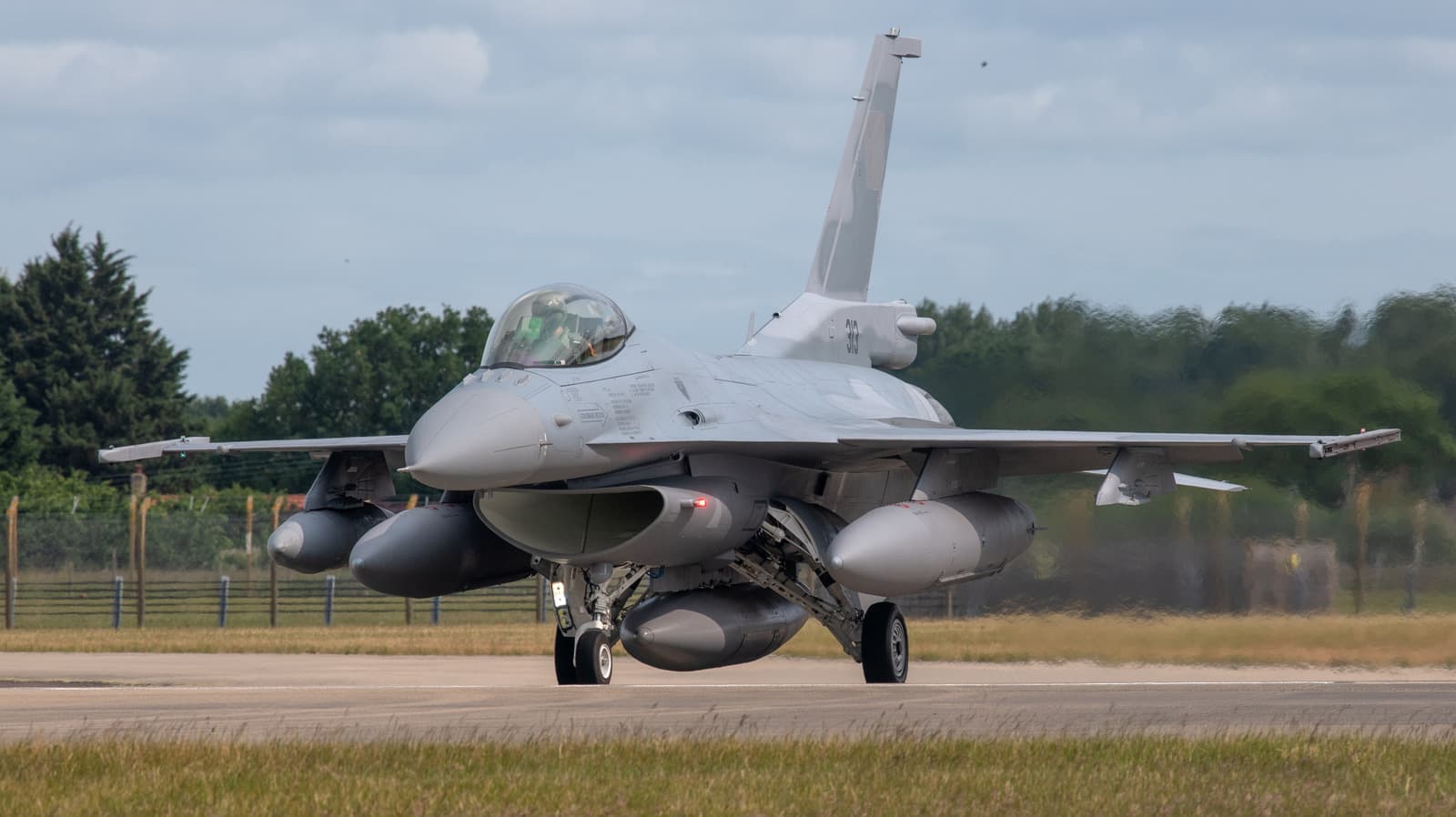
A Rare Military Sighting Over the Lone Star State
Every so often, the skies above the United States play host to military aircraft that aren't actually destined for American squadrons. Defense enthusiasts and sharp-eyed observers in Texas recently caught a glimpse of something remarkable: an F-16 Block 70 fighter jet cutting through the air over the state — one of the very first examples of this advanced variant built for Taiwan's Air Force. It's the kind of sighting that reminds aviation fans just how much international military aviation activity takes place right here on American soil, largely out of public view.
The aircraft was spotted during what are standard pre-delivery test flights, a routine but critical phase in the lifecycle of any military jet before it reaches its final operator. For those who follow defense procurement closely, this sighting was a major milestone — representing years of diplomatic negotiations, engineering upgrades, and geopolitical significance all rolled into a single airframe banking over the Texas horizon.
What Exactly Is the F-16 Block 70?
The F-16 Block 70, also marketed as the F-16V (the "V" standing for Viper), is the most advanced production variant of the legendary Fighting Falcon currently available for export customers. Developed by Lockheed Martin, this version of the F-16 incorporates a substantial suite of modern upgrades that dramatically enhance its combat capability compared to earlier variants that have been in service since the 1970s and 80s.
Key Upgrades That Set the Block 70 Apart
- Active Electronically Scanned Array (AESA) Radar: The Block 70 is equipped with the Northrop Grumman AN/APG-83 Scalable Agile Beam Radar (SABR), a next-generation AESA radar system that offers dramatically improved target detection, tracking, and electronic attack capabilities compared to the mechanically scanned arrays found in older F-16 variants.
- Advanced Cockpit System: Pilots benefit from a modernized glass cockpit featuring a large-format display, improved situational awareness tools, and a more intuitive human-machine interface that reduces pilot workload during high-intensity missions.
- Automatic Ground Collision Avoidance System (Auto-GCAS): This life-saving technology has already been credited with preventing numerous crashes and is now standard on the Block 70, automatically recovering the jet if the pilot becomes incapacitated or disoriented near the ground.
- Structural Enhancements: The airframe has been reinforced to extend the service life of the aircraft significantly, allowing operators to fly the jet well into the mid-21st century without major structural concerns.
- Improved Electronic Warfare Suite: Enhanced jamming and self-protection systems make the Block 70 better equipped to survive in highly contested airspace against modern air defense systems.
Together, these upgrades make the F-16 Block 70 a genuinely formidable fourth-generation-plus fighter, capable of competing effectively in many operational scenarios against much newer adversary aircraft.
Why Taiwan Is Receiving New F-16s
Taiwan's acquisition of new F-16 Block 70 aircraft is the result of a long and politically sensitive arms sale process. The United States approved the sale of 66 new F-16V jets to Taiwan back in 2019, a deal valued at approximately $8 billion. The sale was seen as a significant show of American support for Taiwan's self-defense capability, coming amid rising tensions in the Taiwan Strait and increasing assertiveness from the People's Republic of China regarding its claims over the island.
Taiwan already operates a sizeable fleet of older F-16A/B aircraft, many of which have been or are being upgraded to the Block 70 standard through a separate modernization program. The addition of brand-new Block 70 airframes, however, represents a step beyond mere upgrades — it gives Taiwan's Air Force jets built from the ground up with the latest technology baked in from the start, offering greater long-term reliability and performance.
For Taiwan, air superiority is not an abstract military concept — it is a cornerstone of the island's broader defense strategy. Maintaining a credible air force capable of deterring aggression and defending its airspace is considered essential by defense planners in Taipei.
Test Flights in Texas: Why Here?
The Fort Worth, Texas area is the natural home for F-16 test activity because it is where Lockheed Martin's sprawling production facility is located. The nearby Naval Air Station Joint Reserve Base Fort Worth — commonly known as NAS JRB Fort Worth or Carswell Field — provides the operational infrastructure needed to support these flights. When Lockheed Martin completes an aircraft destined for a foreign customer, test pilots put it through its paces locally before the jet is officially handed over and ferried to its new home country.
This means that observant Texans and aviation enthusiasts near Fort Worth are occasionally treated to the sight and sound of jets that will never serve in the U.S. military flying directly overhead. It's a uniquely American phenomenon, born from the fact that the United States remains the world's dominant exporter of advanced military aircraft.
The Broader Strategic Picture
The appearance of this F-16 Block 70 over Texas is more than just an exciting aviation sighting — it is a visible data point in a much larger geopolitical story. U.S. arms sales to Taiwan serve a dual purpose: they provide Taiwan with genuine defensive capability while simultaneously signaling American commitment to the island's security under the framework of the Taiwan Relations Act.
Critics of such sales argue they risk inflaming tensions with Beijing, while supporters contend that a well-armed Taiwan is actually more stable because it raises the costs of any potential military action and thereby deters conflict. Either way, each new F-16 Block 70 that rolls off the Lockheed Martin production line and takes its first flight over Fort Worth is a physical embodiment of that ongoing strategic calculus.
What This Means for Aviation Enthusiasts and Defense Watchers
For those who track military aviation, spotting a foreign-destined F-16 Block 70 in American skies is a rare treat. These aircraft are operationally identical in most respects to what the U.S. Air Force flies, yet they carry a different story — one of international alliance, defense diplomacy, and the global reach of American aerospace manufacturing. If you live near Fort Worth and hear the unmistakable roar of an F-16 overhead, there's a real chance you might be watching a piece of aviation history on its maiden voyage before it heads to a new life on the other side of the world.
The F-16 Block 70 destined for Taiwan is a testament to how a decades-old airframe, when continuously upgraded and refined, can remain one of the most relevant and capable fighters in the world. And for now, at least, you can catch a glimpse of it flying right here in the United States — over the wide, open skies of Texas.