
A Race Against Gravity: NASA's Most Ambitious Satellite Rescue Plan
Space is unforgiving. Once a spacecraft begins its slow, inevitable drift toward Earth's atmosphere, the clock starts ticking. For NASA's Swift observatory — a $500 million astrophysics mission that has spent two decades scanning the sky for gamma-ray bursts and other high-energy cosmic events — that clock is ticking louder than ever. With its orbit decaying and re-entry on the horizon, NASA faced a stark choice: let one of its most productive telescopes burn up in the atmosphere, or attempt something that has never been done before.
NASA chose the latter. What followed was a crash program that brought together government ambition, startup agility, and cutting-edge robotics in a way the space industry has rarely seen. The question now is whether it will actually work.
How a Startup Won NASA's Confidence in Record Time
In August 2024, NASA's astrophysics division reached out to three companies with an extraordinary ask: could any of them design, build, and launch a satellite capable of rescuing Swift — all within less than a year and on a tight budget? The response that stood out came from Katalyst Space Technologies, a startup founded in 2020 that had been quietly developing on-orbit servicing technology.
"They came back with a response that was technically and programmatically plausible, and then we were like, 'Yeah, let's do it,'" said Shawn Domagal-Goldman, director of NASA's astrophysics division.
That level of confidence is not handed out easily at NASA. Government space programs are notorious for their multi-year development timelines and billion-dollar budgets. The fact that a five-year-old startup managed to clear that bar in a competitive evaluation speaks volumes about both the urgency of the situation and the maturity of the commercial space sector.
In September 2024, NASA awarded Katalyst a $30 million contract — a remarkably lean budget for a mission of this complexity. The company was tasked with building, testing, and launching a small spacecraft capable of chasing down Swift in orbit, physically latching onto it, and pushing it back to a safe operating altitude.
Meet the Link: Katalyst's Robotic Servicing Spacecraft
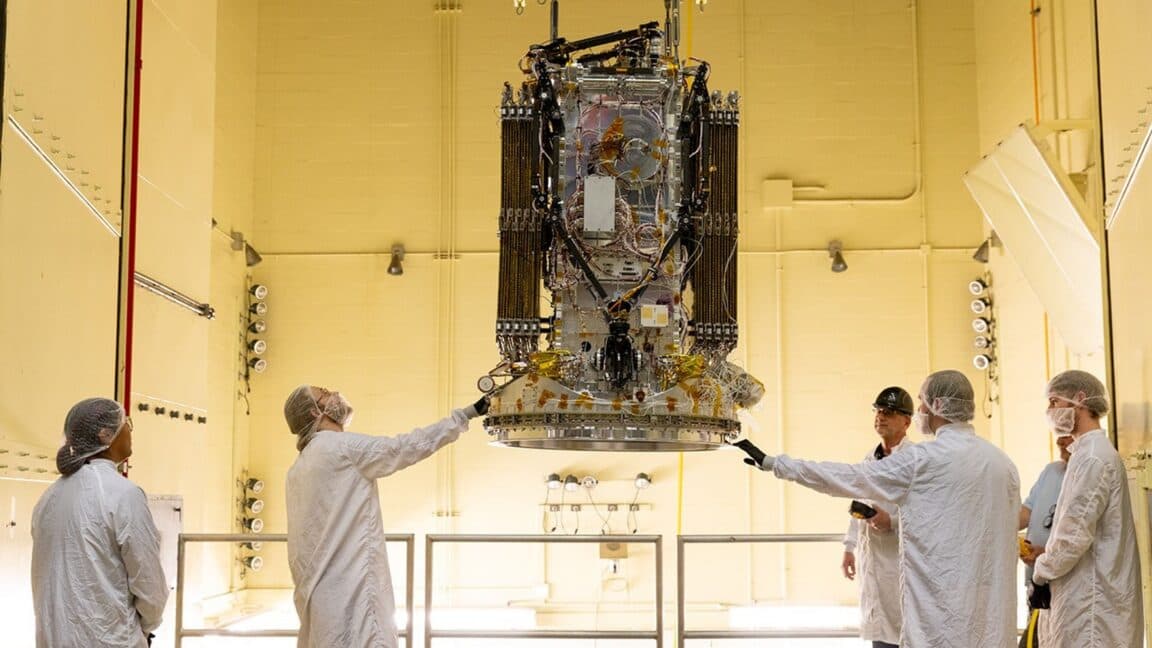
The spacecraft at the center of this rescue story is called Link, and it is not your typical satellite. Rather than carrying scientific instruments or communications payloads, Link is essentially a robotic tow truck designed for life in orbit. Its most distinctive feature is a set of three robotic arms that will be used to grapple Swift and hold on during the orbital boost maneuver.
On-orbit satellite servicing is a concept the space industry has long discussed, but practical demonstrations remain rare and technically demanding. Spacecraft were not originally designed to be grabbed or refueled by another vehicle. Latching onto a target that was never built with servicing in mind — especially one that may be slowly tumbling — requires sophisticated guidance, navigation, and control systems working in tight coordination.
Katalyst's approach involves matching Link's orbit precisely with Swift's, approaching at extremely low relative velocity, and then using its robotic arms to secure a firm grip on the aging observatory. Once attached, Link's propulsion system would fire to gradually raise Swift's orbit, buying the telescope additional years of operational life.
Why Swift Is Worth Saving
Launched in 2004, the Neil Gehrels Swift Observatory has been one of NASA's most scientifically productive assets. It was designed primarily to detect gamma-ray bursts — the most energetic explosions in the universe — and respond to them faster than any previous mission. Over the years, Swift has also contributed to studies of supernovae, black holes, neutron stars, and even comets and asteroids within our own solar system.
Its multi-wavelength capabilities, combining gamma-ray, X-ray, ultraviolet, and optical instruments in a single spacecraft, have made it a uniquely versatile tool for the astronomy community. Losing Swift to an uncontrolled re-entry would not just mean the loss of a single instrument — it would create a significant gap in humanity's ability to respond rapidly to transient cosmic events.
With NASA's science budget under increasing pressure, building a replacement from scratch is not a realistic near-term option. Extending Swift's life through a servicing mission, even at $30 million, is far more cost-effective than starting over.
The Broader Implications for On-Orbit Servicing
Beyond the fate of Swift itself, this mission represents a potential turning point for the entire concept of satellite servicing. If Katalyst's Link spacecraft succeeds, it will demonstrate that commercial companies can step in rapidly to extend the life of government assets in orbit — a capability with enormous implications for both NASA and the Department of Defense.
The space economy is increasingly built on the idea that satellites should be maintainable, refuelable, and upgradeable rather than disposable. But that vision has largely remained aspirational. A successful Swift rescue would provide a real-world proof of concept, showing that robotic on-orbit servicing can be done quickly, affordably, and reliably with today's technology.
It could also open the door to a new category of commercial space services, where companies like Katalyst compete for contracts to maintain government and commercial satellites rather than letting aging spacecraft become expensive debris.
A Mission That Pushes Every Boundary
Everything about this mission has been a sprint. From contract award to launch, the team has had less than a year to accomplish what normally takes several years of careful engineering work. That kind of pace demands a culture of rapid iteration, smart risk management, and deep technical expertise — exactly the qualities that successful space startups have been cultivating over the past decade.
Whether Link ultimately succeeds in its rescue of Swift remains to be seen. The technical challenges are real, the timeline has been brutal, and the margin for error in orbit is essentially zero. But the fact that this mission exists at all — conceived, funded, and built in record time — is itself a remarkable achievement for NASA and the commercial space sector alike.
The eyes of the astronomy world will be watching closely. If it works, it won't just save one telescope. It could change how humanity thinks about every spacecraft we send to orbit from here on out.