
Quantum Error Correction Could Arrive by 2028 — Here's Why That Matters
The quantum computing industry has long operated on a familiar rhythm: major announcements cluster near the end of each year as companies race to demonstrate they are hitting development milestones on schedule. But this summer has broken that pattern in a striking way. A wave of significant announcements has arrived ahead of schedule, and the most headline-grabbing among them is a bold promise that useful, error-corrected quantum computing could be a reality as soon as 2028.
If that timeline holds, it would represent a dramatic acceleration beyond what most experts in the field currently expect. Understanding why this promise is so significant — and what it would actually take to fulfill it — requires a closer look at one of the most fundamental challenges in quantum computing: the problem of errors.
Why Quantum Computing Has an Error Problem
Unlike classical computers, which process information in stable binary bits (zeros and ones), quantum computers operate using qubits. Qubits exploit the principles of quantum mechanics to exist in superpositions of states, enabling a quantum processor to evaluate enormous numbers of possibilities simultaneously. This theoretical power is immense, but it comes with a serious practical drawback: qubits are extraordinarily fragile.
Physical qubits are highly sensitive to their environment. Heat, electromagnetic interference, and even tiny vibrations can introduce errors into a computation. These are not the kind of errors a classical processor encounters — they are probabilistic, difficult to detect, and can cascade through a calculation in ways that render the final result meaningless. For simple demonstrations or narrow benchmarking tasks, today's error-prone hardware can still produce interesting results. But for the complex, real-world problems that make quantum computing truly valuable — drug discovery, materials science, cryptography, financial optimization — current hardware simply is not reliable enough.
This is why error correction is considered the gateway to genuinely useful quantum computing.
What Is Quantum Error Correction and Why Does It Change Everything?
Quantum error correction works by linking multiple physical qubits together to form a single logical qubit. Rather than trusting one fragile physical qubit to hold information reliably, a logical qubit distributes and redundantly encodes that information across a collection of physical qubits. Neighboring qubits in this arrangement — often called ancilla or syndrome qubits — can be measured to detect when and where errors have occurred, allowing the system to correct mistakes in real time without disturbing the underlying computation.
This approach is powerful but enormously resource-intensive. Depending on the error correction code used and the error rates of the underlying hardware, creating a single high-quality logical qubit could require anywhere from dozens to thousands of physical qubits. This is why progress toward error-corrected quantum computing has been measured in incremental steps, and why the mainstream view among researchers has been that truly useful quantum computers are still five to ten years away.
A promise of useful, error-corrected quantum computing by 2028 challenges that consensus directly.
The 2028 Promise: Ambitious but Not Without Basis
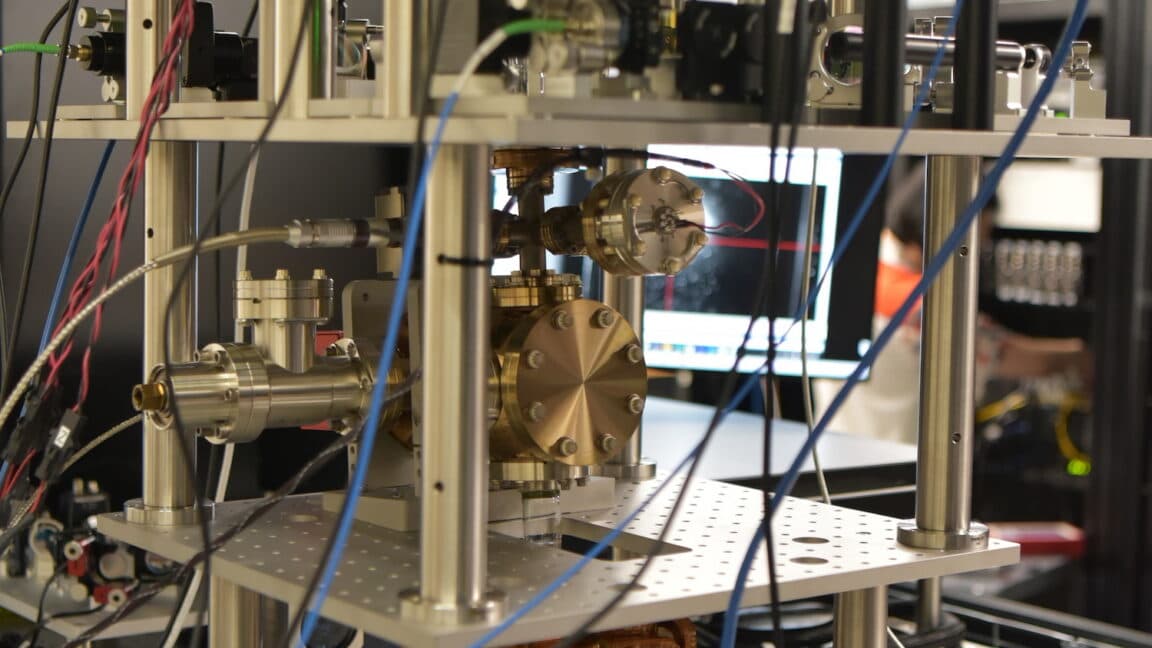
The announcement of a 2028 target is remarkable not just for its boldness but for the context surrounding it. It arrives alongside other notable developments in the field, including updates to trapped ion processor technology — one of the leading hardware platforms in the race toward fault-tolerant quantum computing. Trapped ion systems work by suspending individual ions using electromagnetic fields and manipulating their quantum states with precisely calibrated lasers. They have historically offered lower error rates than competing technologies like superconducting qubits, though they have faced challenges in terms of speed and scalability.
Progress on these systems, combined with advances in error correction codes and the engineering challenges of scaling up qubit counts while keeping error rates low, is what underpins the optimism behind a 2028 target. While skepticism is warranted — the history of quantum computing is littered with timelines that slipped — the pace of development over the past two to three years has genuinely surprised many observers.
Quantum Supremacy Claims Get a Reality Check
Not all of the recent news has been purely celebratory. Alongside the forward-looking announcements, there has been a notable pullback in some previously made claims of quantum supremacy. Advances in classical algorithms — the kind that run on today's conventional computers — have demonstrated that certain tasks once thought to require a quantum processor can be handled more efficiently by improved traditional methods than was previously believed.
This is a healthy and important dynamic in the field. Quantum supremacy, the point at which a quantum computer performs a task that no classical computer could complete in a reasonable timeframe, is a moving target. As researchers develop better classical algorithms, the bar for demonstrating genuine quantum advantage rises. This doesn't diminish the long-term promise of quantum computing, but it does reinforce the importance of pursuing applications where quantum hardware offers fundamental, not merely marginal, advantages.
What a 2028 Timeline Would Mean for Industry and Research
If error-corrected quantum computing does arrive by 2028, the implications would be far-reaching. Industries ranging from pharmaceuticals to logistics to cybersecurity would face both enormous opportunities and significant disruptions. Encryption protocols currently considered secure could become vulnerable, accelerating timelines for the adoption of post-quantum cryptographic standards. Drug discovery pipelines could be transformed by the ability to simulate molecular interactions at quantum scales. Financial institutions could gain powerful new tools for portfolio optimization and risk modeling.
For researchers and developers, a 2028 horizon means the time to begin designing quantum-ready workflows and exploring hybrid classical-quantum algorithms is not some distant future concern — it is now.
The Road Ahead: Cautious Optimism Is Warranted
The summer 2025 announcements paint an unusually dynamic picture of the quantum computing landscape. A credible promise of useful error correction by 2028, continued hardware improvements in trapped ion systems, and a more honest accounting of where quantum advantage truly exists all suggest that the field is maturing rapidly — moving from theoretical promise toward engineering reality.
Whether 2028 proves to be the inflection point the industry is reaching for remains to be seen. But the conversation has shifted. For the first time in a long while, the question is no longer whether useful quantum computing will arrive — it is whether the world will be ready when it does.