
Taiwan's Drone Defense Strategy: A $6.6 Billion Bet Against Chinese Aggression
In one of the most consequential defense spending decisions in its modern history, Taiwan is placing an enormous wager on unmanned aerial vehicles. As tensions with Beijing continue to simmer across the Taiwan Strait, the self-governing island democracy is accelerating its military drone program at a pace that would have seemed extraordinary just a few years ago. With a proposed $6.6 billion budget, international defense partnerships, and a citizenry actively training on drone technology, Taiwan is making clear that unmanned systems sit at the very heart of its survival strategy.
Why Drones Have Become Central to Taiwan's Defense
Taiwan's strategic situation is unlike almost any other nation on earth. Separated from mainland China by just 110 miles of open water, the island faces a Chinese military that has grown exponentially in capability and ambition over the past two decades. Any attempted invasion would likely involve massive amphibious and airborne assaults, and Taiwan's military planners have long understood that conventional force-on-force resistance alone would be insufficient.
Drones offer a compelling asymmetric solution. They are relatively inexpensive to produce at scale, difficult to intercept in large numbers, and highly effective at targeting naval vessels, landing craft, and coastal assault formations. Military strategists often refer to this approach as "porcupine defense" — making an invasion so costly and painful that it becomes effectively impossible to execute without catastrophic losses. In that context, drones are not merely weapons; they are a deterrent in their own right.
Taiwan's Ministry of National Defense has framed the issue in precisely these terms. The island's continued existence as a democracy, officials have argued, may depend directly on accumulating enough drone firepower to raise the cost of any Chinese military action to an unacceptable level.
The $6.6 Billion Budget Proposal Explained
Presented on June 18, 2025, Taiwan's Ministry of National Defense put forward a special budget proposal that would allocate $6.6 billion over six years — from 2026 to 2031 — exclusively for domestically manufactured military drones. The scale of the planned procurement is staggering by any measure.
- More than 208,000 coastal attack drones intended for use against seaborne invasion forces attempting to reach Taiwan's shorelines.
- Over 1,400 coastal reconnaissance drones designed to provide persistent surveillance of Taiwan's surrounding waters and early warning of approaching threats.
- 1,320 uncrewed surface vessels (USVs) to extend the island's defensive perimeter beyond the shoreline and into the surrounding maritime environment.
The proposal represents a dramatic leap from Taiwan's current inventory. According to Resilience Media, Taiwan's existing drone arsenal stands at approximately 5,000 units — a combination of US-made attack drones and domestically produced systems. The new budget would multiply that inventory more than fortyfold within six years, fundamentally transforming the island's defensive posture.
Live Exercises Signal Real Operational Capability
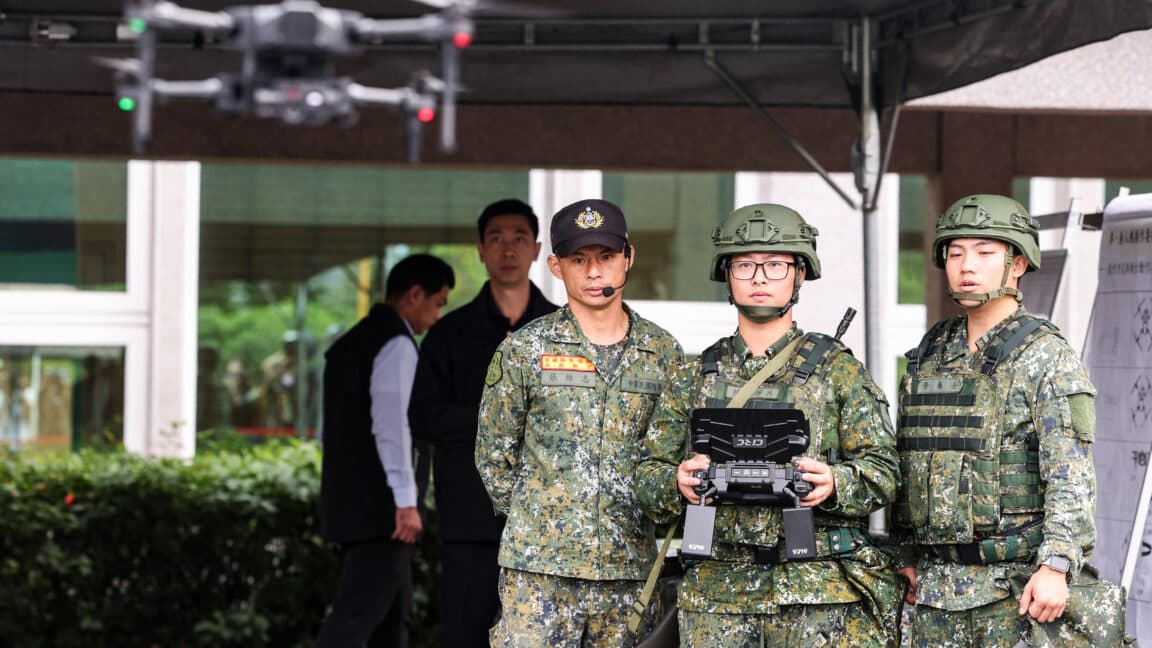
The urgency behind Taiwan's drone push is not merely theoretical. In military exercises conducted in early June 2025, Taiwanese soldiers demonstrated the operational deployment of Altius-600 loitering munitions — sophisticated attack drones manufactured by AMMO, a subsidiary of the American defense technology company Anduril Industries. Launched from towed flatbed platforms, these drones successfully engaged offshore targets in a scenario designed to simulate the destruction of approaching naval assets.
Earlier in 2025, Taiwanese Marines conducted separate exercises using Taiwan-made drones to strike maritime targets, demonstrating that domestic production is already yielding combat-capable systems rather than prototype-stage technology. These exercises are not simply training events; they are calculated signals to Beijing that Taiwan's drone capacity is real, tested, and growing.
International Partnerships: Taiwan and the US Military
Taiwan is not developing its drone industry in isolation. Taiwanese defense companies are actively building international partnerships — most notably with American defense firms — to expand both their technological capabilities and their export markets. Selling drones to the US military and other allied buyers serves multiple purposes simultaneously: it generates revenue to fund further domestic research and production, it deepens interoperability with allied forces, and it raises the political and strategic stakes for any nation that might consider threatening Taiwan's security.
The relationship with US defense contractors like Anduril Industries illustrates how tightly integrated these partnerships have become. American loitering munitions are already being tested on Taiwanese soil, fired by Taiwanese soldiers, in exercises designed around Taiwan's specific defensive geography. That level of integration goes well beyond a simple arms sale — it represents a convergence of strategic interests that strengthens Taiwan's position within the broader framework of Indo-Pacific security.
Citizens Training for a Drone-Enabled Defense
Perhaps the most striking dimension of Taiwan's drone strategy is its civilian component. Taiwanese citizens have been signing up for drone flight training programs, reflecting a broader societal understanding that national defense in the modern era requires a digitally literate, technically capable population. This grassroots mobilization mirrors strategies seen in Ukraine, where civilian drone operators have played a meaningful role alongside professional military units.
By building drone expertise across both its military and civilian population, Taiwan is developing a depth of capability that cannot easily be destroyed or neutralized. A drone-capable citizenry represents a form of distributed defense that is inherently resilient.
The Bigger Picture: Drones and the Future of Indo-Pacific Security
Taiwan's aggressive pivot toward drone-centric defense carries implications that extend far beyond the Taiwan Strait. It signals to other nations in the Indo-Pacific — Japan, South Korea, the Philippines, and beyond — that unmanned systems are becoming the defining military technology of the era. It also reinforces the value of the US-Taiwan defense relationship at a moment when American policymakers are debating the depth of that commitment.
For China's military planners, the message is equally clear. An island that once seemed potentially vulnerable to a swift and decisive amphibious operation is rapidly becoming a fortified, drone-saturated environment where any invasion force would face extraordinary attrition before it ever reached the beach.
Whether Taiwan's $6.6 billion drone investment is ultimately enough to guarantee its security remains an open question. But the direction of travel is unmistakable: Taiwan is building the world's most densely drone-defended coastline, and it is doing so with growing speed, growing capability, and a resolute determination to remain free.