
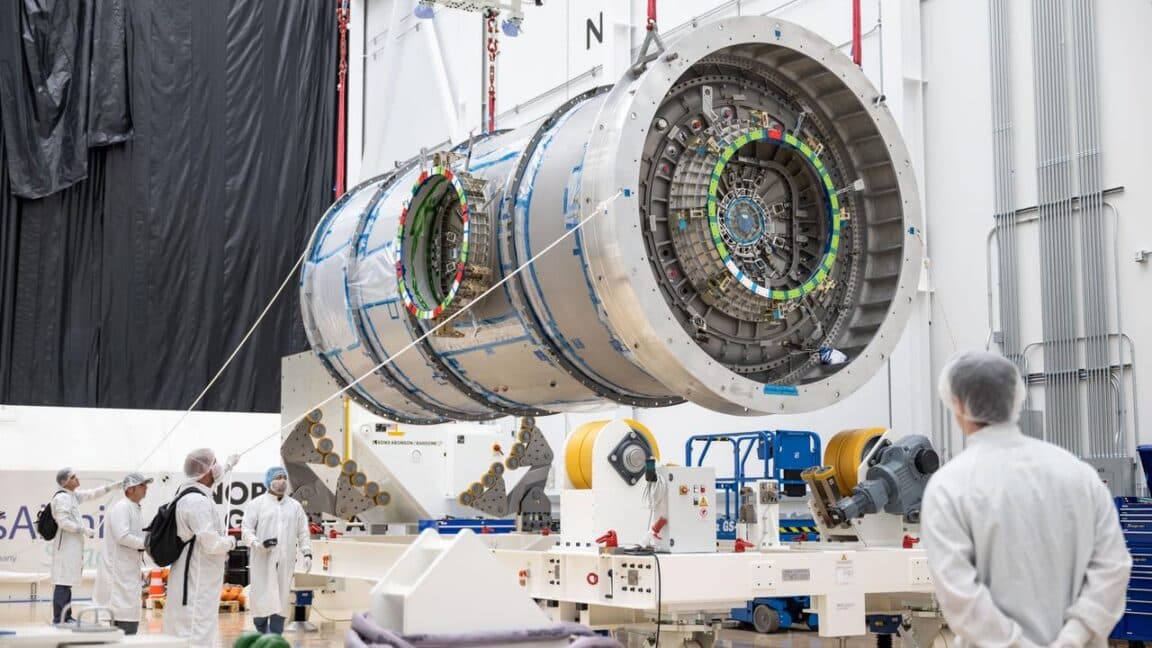
NASA Orders Northrop Grumman to Stop Work on the Lunar HALO Module
In a significant shift in America's lunar exploration strategy, NASA has directed aerospace contractor Northrop Grumman to cease work on the Habitation and Logistics Outpost, widely known as the HALO module. This decision marks the latest development in a sweeping reorganization of NASA's Moon plans, one that moves the agency away from constructing an orbital space station and toward establishing a physical base on the lunar surface. The move has raised serious questions about the future of billions of dollars in contracts, years of engineering work, and the broader vision for sustained human presence near the Moon.
What Is the HALO Module?
The Habitation and Logistics Outpost, or HALO, was designed to serve as the primary living and working space for astronauts visiting the Lunar Gateway, a planned space station intended to orbit the Moon. Measuring 6.1 meters in length, the pressurized module was engineered to house visiting crews during their time aboard the Gateway, providing life support systems, sleeping quarters, and essential logistics infrastructure.
NASA awarded contracts totaling approximately $1.1 billion to Northrop Grumman to design, build, and integrate the HALO module with another key component, the Power and Propulsion Element (PPE). Together, these two modules represented the most advanced and developed pieces of the Lunar Gateway program. Northrop Grumman had been making steady progress on the HALO module over several years, and the halt order represents a major disruption to that work.
NASA's Pivot: From Orbital Station to Lunar Surface Base
The decision to pause HALO development did not come out of nowhere. Roughly three months before the work stoppage directive, NASA made a high-profile announcement at its Washington, DC, headquarters that signaled a dramatic change of direction. Agency officials stated that the Lunar Gateway—once considered a cornerstone of the Artemis program's long-term architecture—would no longer be the central focus of NASA's lunar ambitions.
Instead, NASA declared its intent to prioritize building a permanent or semi-permanent base directly on the surface of the Moon. This approach, officials argued, would offer more direct scientific value and serve as a stronger proving ground for the technologies and operational techniques that would eventually be needed for crewed missions to Mars.
As part of this restructuring, NASA revealed that the Power and Propulsion Element would not be scrapped but repurposed. Rather than serving as the power backbone of the Lunar Gateway, the PPE would be redirected to function as a core module for a nuclear-electric propulsion demonstration in deep space—a mission that aligns with NASA's longer-term goals for interplanetary travel. The fate of the HALO module, however, was left far less defined at that initial announcement, leaving Northrop Grumman and industry observers in a state of uncertainty.
The Financial and Industrial Impact
The decision to stop HALO development carries significant financial consequences. With over $1.1 billion in contracts tied to the module's design, build, and integration, halting the program mid-development means sunk costs that cannot be easily recovered. Northrop Grumman had invested substantial engineering hours and resources into the project, and stopping now raises complex questions about contract termination clauses, workforce impact, and the reallocation of specialized personnel.
Beyond Northrop Grumman, the ripple effects extend throughout the aerospace supply chain. Dozens of subcontractors and suppliers involved in producing components for the HALO module now face uncertainty about their own contracts and future work. For a sector that depends heavily on government programs for stable, long-term revenue, such abrupt pivots can be deeply disruptive.
What Happens to the Lunar Gateway Now?
With both of the Lunar Gateway's most developed components now being paused or redirected, the future of the entire orbital station concept is in serious doubt. The Gateway had been envisioned as a critical waypoint for Artemis missions—a place where astronauts could transfer between deep-space transport vehicles and lunar landers, and where science experiments could be conducted in a unique orbital environment around the Moon.
Proponents of the Gateway model had long argued that an orbital station provides far greater flexibility than a surface base alone. It allows access to multiple sites on the lunar surface, supports longer mission durations, and serves as a staging point that reduces the fuel requirements for landing and returning to Earth orbit. Critics, on the other hand, have questioned the cost and complexity of building and maintaining an orbital facility when surface-based infrastructure could deliver comparable or greater scientific returns more efficiently.
NASA's current posture suggests the agency has sided with the critics, at least for now. Whether the Lunar Gateway concept could be revived under a future administration or with different budget conditions remains an open question.
Looking Ahead: NASA's Evolving Moon Strategy
The pause on the HALO module is a vivid illustration of how rapidly NASA's strategic priorities can shift in response to political direction, budget realities, and evolving scientific goals. As the Artemis program continues to navigate turbulence—including schedule delays, cost overruns, and changing White House priorities—decisions like this one will continue to reshape what America's return to the Moon ultimately looks like.
- The HALO module's halt leaves a $1.1 billion investment in limbo and raises workforce concerns at Northrop Grumman.
- NASA's pivot to a lunar surface base reflects a broader strategic reassessment of how best to achieve sustained human presence on and around the Moon.
- The Power and Propulsion Element will be repurposed for a nuclear-electric propulsion demonstration, preserving some value from the Gateway program's development work.
- International partners who had committed to contributing modules and resources to the Lunar Gateway now face uncertainty about their own roles in NASA's revised lunar architecture.
For space exploration advocates, the uncertainty surrounding HALO is both a concern and a reminder that major government programs are rarely straightforward. The technologies developed, the lessons learned, and the workforce trained during the HALO program are not lost—they represent a reservoir of knowledge that will inform whatever comes next, whether that is a surface habitat, a future orbital outpost, or pioneering systems for deep-space travel.
NASA's decision to halt HALO module development is not the end of American ambitions on and around the Moon. It is, however, a clear signal that those ambitions are being fundamentally reimagined, and that the path forward will look very different from the one that was charted just a few years ago.